Saturday, August 24, 2013

The Paths We Walk

Fear or concern for a lack for resources for our continued survival drives us towards community or tribalism. Whether individuals or corporate entities, all begin from this position.

One is a legitimate concern for a lack for resources for continued survival. This ultimately will lead to co-dependence and build Community. The belief that our pooled resources are more valued than our individual resources.

The other is the Fear of a perceived lack for resources - possibly motivated by error, paranoia, or greed. Ultimately the lack of resources in this case isn't real. It is based upon fear and the error that their resources are a commodity; that their resources make them powerful compared to others.

There is a difference between fear and concern, but in this early stage they are difficult in not impossibly to differentiate. Early on, I am sure both are true to some degree. It only becomes important when a direction of growth occurs. Either one can easily morph into the other in these early formative stages. But ultimately once their footing is established they will develop along distinctively difference paths.

A legitimate concern for a lack of resources necessary for continued survival will build Community. This kind of social structure will eventually begin non-zero-sum thinking. It will also see the introduction of a limited or conditional compassion. This is important because, further down the road, there's the potential for the birth of true Compassion.


A perceived fear of a lack of resources (or simply a desire for a surplus) will breed Tribalism. This kind of social structure views the world in zero-sum terms. It has no choice but to develop Envy. Not only coveting what another has (whether an individual or rival tribe) but believing the other's loss is somehow their gain.

It is important to understand that we are redefining the terms Community and Tribalism here to identify two separate paths of development. These paths can and do apply to individuals, institutions, and corporate entities. 
But it is critically important that we pause for a moment and thoroughly understand what is meant by "resources". 
Yes, most definitely "resources" can mean food & shelter. But it can also include safety & security, affection & love. Even a newborn baby finds itself in this position of 'being driven by fear and/or concern for a lack of resources towards community or tribalism'. Its mother's milk and safety and warmth & affection are the baby's "resources". Its community or tribe can be its mother's relationship and family. It can live in community with its siblings, or it can live in tribal competition with them. 
But "resources" can be expanded to include a great many things. Resources can be anything needed - or perceived to be needed - for continued survival. For example, from a religious industry point of view, Salvation could meet these criteria. After all, by this thinking, Salvation is needed for "continued survival". And if this resource is mistaken for a commodity (power), we are led well into Tribalism.
Continuing along this path from Tribalism and its zero-sum mindset, there is no other direction for development but eventually to embrace Envy. And as mentioned earlier, Envy not only allows oneself to justify why they deserve what another has, it also can allow them to rationalize why the other doesn't even deserve what it has. Envy is created by Fear and breeds hatred.

But the individual or group/institute/entity/etc. is not yet without hope. At some point - whether directly or indirectly - they will be forced to face the fact that this Envy is at their heart or center. It is at this point where Confusion enters.

Although existing in a state of Confusion is not good or healthy, there is at least the potential for change and growth.

It is at this point where two paths emerge.

One path (Reflection) reverses its direction. It identifies the unfounded Fear that initially created its tribalism, accepts the truth for what it is ("Dharma"), purges its Envy and Fear, and undoes it. It learns and grows and evolves in a more positive and healthy direction.

In its alternate path (Denial) it continues in its Confusion, in denial of the truth. It attempts to justify and keep its Envy. It will delude itself into believing in a mock-compassion in order to perpetuate the illusion of community; this mock-compassion being really little more than Pity. In reality it practices Pity and Envy but convinces itself that it is Compassion and Righteousness.

At this point their ability to lie to themselves is well established; they have believed their own lies and non-truths. They have entered an existence of Delusion.

Delusion, Envy, and Fear are the key operative demons, with each solidifying and strengthening the other. It is a difficult position to escape from, primarily because there is no desire to escape. Its defense is to have convinced itself that it is right and correct - no change is needed. (On a side note, I think this is what ails modern day Christianity. It has evolved down this path of Tribalism under the disguise of "Community". It has mistakenly justified its Pity as Compassion and Envy as Righteousness. Where it should have followed another path...)

These are the paths to Entrapment. These are the warnings we must be aware of and mindful of. But what is a better path? What is it that we should strive for?


Once we can find ourselves able to Reflect is the turning point.
It is the escape from a state of Confusion.
It is the beginning of the end of being Ego-centric.
It is at this point that we self-question, self-analyze, and when Doubt enters.
Contrary to much religious thought, Doubt is anything but a lack of faith. Doubt is hope. Doubt is the beginning of spiritual growth. It is the prerequisite to approaching The Mu Portal.  Without Doubt we cannot self-assess.
Once we can begin to purge our competitive habits - our Envy, Fear, Delusions - once we can clear the Confusion and abandon our Tribal zero-sum thinking and begin embracing true Compassion, "Dharma", and begin finding Solace for ourselves are we on a healthy and spiritually enriching path - not only for ourselves, but for all those around us.

~

This confusing and seemingly meandering path applies to everyone and everything. Whether they are individual beings, organized institutions, religions, businesses, social groups, or corporate entities. The paths we walk apply to our internal, individual journeys, as well as to how our communities function and grow or stagnate.
Only if we are aware of the paths we walk, do we have any hope to effect their directions.


Compassion & Envy - Dharma & Delusion

Unwholesome thoughts are those that (are not conductive to freedom and happiness, but rather) promote suffering.
Unwholesome thoughts (also called unskillful thoughts) are connected to selfish desire, hatred, or delusion.
Therefore, selfish desire, hatred, fear, envy, and (especially) delusion promote suffering.

There is a particular pattern of unskillful thinking ("unwholesome thoughts") that most of us regularly practice nearly instinctively. It is a manner of thought strongly encouraged by our competitive culture. (and also fosters zero-sum thinking).

We have the insidious habit of seeing how we measure up to other people ("comparing mind"). Our culture is obsessed with it and thrives on it.

The most damning effect of this 'comparing mind' is the unnecessary suffering it causes. Not only do we feel bad about ourselves, but we begin to wish ill upon others - sometimes to the point where we are willing to take actions to realize those wishes. This is the birth of Envy.

Not only is Envy a stumbling block and obstacle to Compassion, but Envy fetters Compassion.

Compassion is a form of empathy, but much more than that. Compassion is action. It will not just sympathize, it'll do something about it. To only sympathize is Pity. And Pity is a very pale reflection of Compassion.

What will block and impede Compassion is Envy. Yes, there is fear and jealousy, but Envy is much more dangerous and damaging. With Envy there is also the intent or desire - either directly or indirectly - to inflict misfortune or harm onto another. Not only do you desire what they have, you don't wnat them to have what you possess (because what you possess is a commodity and makes you powerful). It is Compassion's opposite and a stumbling block.

Compassion
The capacity for compassion is our deepest nature as human beings. I believe we are all innately good.
(...and on a side note, I also think that doctrines like the Calvinists Total Depravity only further feeds Envy and slowly eliminates Compassion, allowing them to only - at best - show Pity).

Compassion does not require that we feel affection towards others. We can have compassion for our worst enemies. In fact, the very nature of true compassion might necessitate it. Compassion cannot be selective.

Compassion is not Pity, although the two are often easily confused. Pity is simply feeling sorry for someone who has to endure suffering, but pity keeps itself distance from suffering. Pity can't get past the element of fear; it's afraid of pain and suffering and wants to flee from its presence.

Compassion doesn't keep its distance. Compassion is willing to be with suffering up close and personal because it has learned to accept rather than resist pain.

Dharma
Although Dharma is a Buddhist term, I don't see the concept as exclusively Buddhist. I believe the Buddhist's understand it and draw from it, but don't "own" it.

Dharma is our openness and willingness to accept the truth as we discover it. Our receptiveness to it and our ability to allow it lead us, rather than force it to fit our preconceived notions and agendas. Our willingness to allow it to change and direct ourselves rather than twist and coerce and manipulate it.

It is dealing with the struggle and tension between truth and fact. (as they are not the same things).

The truth never needs defending. This is Dharma. Only our truths needs defending. This is Delusion.

If we are open and aware and allow ourselves to be led where ever it is that the truth leads us, we consistently reduce the levels of delusion in our lives.

Delusion is Dharma's enemy.

Sunday, August 4, 2013

Instinct vs. Impermanence

"When we attach ourselves to impermanent objects - sensations, thoughts, feelings, people, things - we are always left with the stress and grief of loss, because everything around us is always changing; it is always being pulled beyond our reach. Our grasping, our fighting against impermanence, results in loss and the suffering that comes with trying to hold on to the constantly changing reality. It's rather like trying to play tug-of-war with a much stronger opponent; we begin to lose, as we always will, we can choose to let go or to hold on and receive the "rope buns" of attachment. The survival instinct tells us to hold on; the Buddha urges us to let go."

"All unpleasant thoughts, feelings, and sensations are impermanent; trying to push them away is futile and results in stress, anger, and suffering. It's as if with our aversion we created a dam in the flow of experience. Rather than letting impermanence do its job, we block the passing of pain. We do this in a variety of ways - through suppression, avoidance  ignoring  self-medicating, or hardening the heart and closing down to life. Again, as a survival instinct aversion is necessary - we have to hate pain to survive - but it doesn't leave us with much freedom or happiness. when it comes to aversion, the survival-based life is a life of fear and loathing. Our instincts tell us to hate pain and try to get rid of it; the Buddha urges us to meet pain with mercy and compassion."

"We can all concede... that everything is impermanent... [T]he evolved human condition has resulted in a brain that creates a self. The sense of being a permanent fixed identity - a self - is a construction of the mind/body. Each one of us is a constantly evolving and unfolding process, not a fixed identity. This aspect of reality - that is, our own changing nature - seems to be at odds with the human survival instinct, so the mind creates a fixed identity that takes everything personally and clings to the notion of "I", "me", and "mind". But this solution is based on ignorance and a lack of investigation. Believing in a permanent self is like believing in a permanent rainbow. We all know that rainbows are temporary optical illusions based on the factors of sunlight, moisture, and heat. The environment creates each rainbow like a mind creates a self. Both creations are relatively real, in that we can genuinely experience them temporarily, but just as the factors that create the illusion (whether rainbow or self) arose, so will they also pass.  There is no permanent self; there is no permanent rainbow. It is not true to say that there is no self at all or that everything is empty or illusory, but it is true that everything is constantly changing and that there is no solid, permanent, unchanging self within the process that is life. Everything and everyone is an unfolding process."


Excerpts from "Wide Awake", by Noah Levine.

Wednesday, July 24, 2013

Wolves and Meditation


Funny thing meditation. Basically, it is nothing but simply sitting down, doing nothing, and being aware.
By strictest definition, it's nearly pointless. Yet that pointlessness make it a radical act as it totally flies in the face of what the world demands of us. The paradox is that this radical act of stopping, doing nothing, and just being mindful can be the most transformative, healing, and positive thing we could ever do... paying attention.

Only the items I notice shape my mind.
Ultimately, what we allow ourselves to notice literally determines our experiences. Attention determines our degree of awareness with our ordinary experiences and shapes the world around us.

Our level of awareness determines the content and quality of our lives.

There's an old Native American story.
A grandfather tells a story to his grandson, "I have two wolves fighting in my heart. One wolf is vengeful, fearful, envious, resentful, deceitful. The other wolf is loving, compassionate, generous, truthful, and serene."
The grandson asks which wolf will win the fight.
The grandfather answers, "The one I feed."


However, if we refuse to deal with or acknowledge what's difficult and painful - ignoring it; pretending it doesn't exist - whatever we neglect withers and retreats below our consciousness, where it may still affect our lives. In a twisted and perverse way, ignoring the painful and the difficult is just another way of feeding the wolf. So it is not only a simple matter of which one we focus on.  Meditation brings us all human experiences and all parts of ourselves - to be aware of both wolves.

Wednesday, July 17, 2013

Tribal Identities

I believe mankind has within it the potential to make a giant evolutionary leap forward - possible into what some might call the Noosphere - and evolve past our tribal condition. But I think this needs some careful thought and introspection.

All great evolutionary leaps and bounds have typically had a catalyst. There was a time I thought humanity needed that catalyst, that 'push' to abandon tribalism and unify. Movies, TV, literature and culture would teach us that a unified threat would do it; like an alien invasion of Earth for example.
...but this isn't the evolutionary jump we're dealing with here. This is just another - granted larger - definition of 'tribe'.

I suspect that we are instinctively hardwired towards tribalism. It's a survival trait that we need - or possibly - needed.

I'm not convinced we still need it.
Although I am convinced that tribalism is alive and well.

...but what draws us to it? Ultimately I think it is identity and our need for it. We create and build our identity (both personal and corporate) from our 'tribes', don't we?

In this multi-billion dollar new age industry of online multiplayer, first-person video games we belong to a team - red team, blue team - it matters little.

Another popular, fun, and entertaining game is Magic, The Gathering.
We can affiliate ourselves with various fictional groups and guilds: The Azorius Senate, House Dimir, the Gruul Clans - all with their own pins, T-shirts, and paraphernalia should we so choose to engage and associate ourselves with one tribe or another. It's all fun.

Too juvenile for you?  Alright. Let's mature and 'grow up' a little then. What about hockey jerseys? Loyalty to one's sports team, be it hockey, American football (...or baseball... or basketball), or European Soccer. It's odd that the degree of seriousness and fanaticism matures along with its "non-juvenile audience".


It provides us with our need for identity (at least temporarily and superficially).

This isn't restricted to our games and recreation and entertainment only. In fact, the more grown-up or serious or important we can make our tribal corporate identities appear, the more 'real' and important our tribes become.

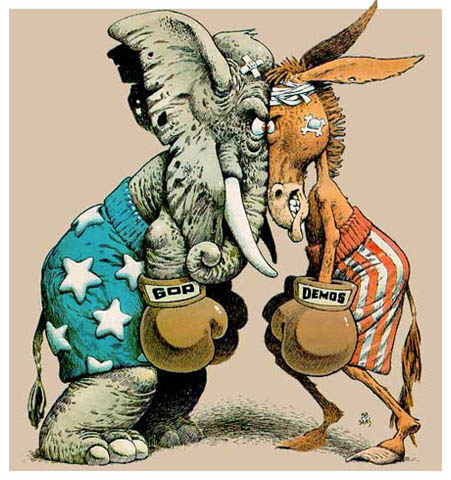
We enter into the world of political affiliations. What are you? A Conservative? A Liberal? Labour? Republican? Democrat? Whether its loyalty to a specific political party (or a cult of personality), or a specific political philosophy, we are generally expected to belong to one.

Through my experiences, most people do not clearly, cleanly, or easily belong under one philosophical political umbrella, but bits and pieces of many. It becomes another artificial piece of our identity.

Not serious or mature or grown-up enough? There's still more. Religious affiliations.
Religious affiliation is all about tribal (corporate) identity. ...Yes, most will venomously deny this. They'll claim their religion is about compassion and love, not tribal identity. But Compassion is an evolutionary step away from Tribalism.
True Compassion and Tribal identity are incompatible.
Compassion necessitates charity of some sort as well as selflessness.
Once we begin down that path of giving up a sense (and definition) of Self, so too do we move away from our delusional sense of Ego and begin distancing ourselves from identity.

The compassion that many religions offer is really just pity. Possibly the real compassion is reserved for the exclusivity of its members, like an insurance policy. But conditional compassion - compassion bound by tribal borders - is not compassion.

Our entertainment, our sports, our political views, and religion, and even our work. All these sources of identity that we seek out and cling to only ever reinforce and build the Ego. Our identities are founded on our Fear, Envy, and Delusion.

Envy is Compassion's opposite, for not only does Envy look out for 'number one' (ourselves), it also desires others not to have and to be without. Envy thrives on their failures as well on its success.

Our fearful and envy-driven Ego embraces a Zero-Sum belief or worldview. In order for there to be a winner, there must be a loser. In order for me to succeed, someone must fail. Paying the workforce less makes more profit.
Every source that supports the Ego and builds our identities subscribe to this. Labour Unions are perfect examples of an Envy-based Zero-Sum system.

The Zero-Sum worldview of the Ego cannot fully understand the concept of Compassion. If I give something away with no return, I simply have less and the other gains. (Capitalism/Consumerism is founded against this). I think this is where many institutional religions fail. Although they are attempting to practice and promote Compassion, they are still stuck in their Zero-Sum views. The only logical justification for Compassion and Charity in a Zero-Sum system is a reward in the afterlife (Paradise, Heaven, etc.), but ultimately this only creates self-serving (albeit well hidden) spiritual hedonists*. (You're only doing it for the fair exchange you're hoping to come in the afterlife).

True Compassion only properly functions in a Non-Zero-Sum system. In fact, Compassion embraces it.
Non-Zero-Sum believes that you can have win-win scenarios.
"It's not whether you win or lose, but how you play the game". My success is dependent upon the team's success. Pay and treat the workforce properly and appropriately and the business will profit.
Universal Health Care is a perfect example. Yes, through taxes, the wealthier will pay to support the less wealthy worker, but a stable and healthy workforce benefits the entire system. There are no losers in this system. This is Non-Zero-Sum.

I think religions functioning within a Zero-Sum worldview had limited potential but was the best we could hope for in its day and age. But I wonder if we are on a spiritual cusp; at the verge of entering a Non-Zero-Sum worldview.

What happens, spiritually, when we decide to abandon our religious identities?
What does this look like? What does that make us become? Could this be this elusive Kingdom of God that Yeshua speaks of? Could this be the clean and clear mind of Enlightenment the Buddha teaches we are already in possession of?
Why are we so driven to find and establish our alleged identities?
Could this very act be what blinds us all?


*(On a side note, I think this is where Paul and Yeshua may differ. I believe the Kingdom of God that Yeshua refers to ("One day the Pharisees asked Jesus, "When will the Kingdom of God come?" Jesus replied, "The Kingdom of God can't be detected by visible signs. You won't be able to say, "Here it is!" or "It's over there!" For the Kingdom of God is within you". Luke 17:20-21, NLT) is a corporate entity that embraces Non-Zero-Sum thinking, while Paul - for all his good intentions - was stuck attempting to understand this Kingdom of God through his Zero-Sum perspective ("I press on to reach the end of the race and receive the heavenly prize for which God, through Christ Jesus, is calling us." Phil. 3:14, NLT).

Monday, July 8, 2013

"God's Favorite Place on Earth" by Frank Viola: Commentary and Review

Allow me to apologize in advance. This short book review is more about me than the book itself. I have often wondered, as a non-Christian (or maybe an ex-Christian... or maybe I never really was a Christian... Good God! maybe the Calvinists were right!), why do I write book reviews of Christian books? And why do book authors and Christian book publishers want my opinions, and why are people (or Christians) interested in my non-Christian thoughts?

Well, ultimately, I think I know why. I may be a non-Christian but I have not totally abandoned everything Christianity has of value. I would rather not define myself as a non-Christian or an ex-Christian, but as simply having moved beyond Christianity (and that necessitates keeping or absorbing at least some aspects and values of it). And that gives me a somewhat clearer vision of what I see, hear, and read.

Christian books in the past that have received bad or poor reviews from me generally have certain unfavourable elements. They use bait-and-switch trickery and mislead; they are too preachy and condemning or judgmental; sometimes they simply can't connect to the common man.

This book however - "God's Favorite Place on Earth" - is none of these things. The author starts out by comparing the tiny town of Bethany to the colossus Jerusalem. I believe the messages and lessons Frank Viola is attempting to communicate are good, simple Christian ones (mind you, for the internal Church-going Christian; not those on the fringe)... but he never seems to get any traction. He failed to ever grab my attention or interest. Although not a long book, I read through it like it was a task, an obligation. (It was as joyous as reading through the book of Leviticus).

I wish I could say or comment more, but unfortunately I have little more to add. It simply wasn't an engaging book.


Disclosure of Material Connection: I received this book free from the author and/or publisher through the Speakeasy blogging book review network  I was not required to write a positive review. The opinions I have expressed are my own. I am disclosing this in accordance with the Federal Trade Commission's 16 CFR, Part 255.


Saturday, June 29, 2013

Entrapment

I believe it was the Buddha that had once said we are all enlightened beings; we just don't know it yet.

Our natural state is enlightened. I'll borrow from the Taoists when I say I believe our innate state is our Wu Wei Nature, it's just blocked.

I call this state, or at least the avenue towards it, The Dharma Entanglement.
Solace and Compassion are entangled by Dharma”.

It's important to understand what these terms are and aren't.

Solace is basically inner peace. Solace calms one's fear of suffering. Fear is its opposite and fear fetters solace.

Compassion is a form of empathy, but much more than that. Compassion is action. It will not just sympathize, it'll do something about it. To only sympathize is Pity. And Pity is a very pale reflection of Compassion.

What will block and impede Compassion is Envy. Yes, there is fear and jealousy, but Envy is much more damaging and dangerous. With Envy there is also the intent or desire (either directly or indirectly) to inflict misfortune or harm onto another. Not only do you desire what they have, you don't want them to have what you possess. It is Compassion's opposite and a stumbling block.

Although Dharma is a Buddhist term, I don't see the concept as exclusively Buddhist. I believe the Buddhist's understand it and draw from it, but don't 'own' it.

Dharma is our openness and willingness to accept the truth, whatever it may be. Our receptiveness to it and our ability to allow it to lead us, rather than force it to fit our preconcieved notions and agendas.

The truth never needs defending. Only our truths needs defending.

If we are open and aware and allow ourselves to be led where ever it is that the truth leads us, we consistently reduce the levels of delusion in our lives.

Delusion is Dharma's enemy.

Solace and Compassion are entangled by Dharma.
These three form The Dharma Entanglement, and this leads us back to our innate Wu Wei Natures.

Fear, Envy, and Delusion lead us astray. They form our illusionary Ego and our Ego entraps us, imprisons us, and stagnates our spiritual growth.

When we associate ourselves with some sort of tribal identity we add to this toxic concoction a Corporate Ego as well.

This tribalism of Corporate Entities can be anything from a favourite sport's team, to a political party or position, to a nationalist (being patriotic), to religious affiliation, and the list goes on.

Saturday, June 15, 2013

The Mu Portal

The Dharma Entanglement is blocked by the encircling Ego.
We are entrapped by our Ego.

Ego is fabricated by three elements; Delusion, Envy, and Fear.
Dharma, Solace, and Compassion compose The Dharma Entanglement and our innate Wu Wei Nature, for Dharma emancipates us from Delusion, Compassion from Envy, and Solace from Fear.

The way forward through these blockades and barriers of the Corporate and Private Ego is through the Mu Portals.

~ ~ ~ ~ ~ ~ ~ ~ ~

The heretical Rabbi, Yeshua of Nazareth, spoke of a strange and elusive concept he called The Kingdom of God. Something that was yet to come, yet strangely present in the Here and Now; within ourselves (Luke 17:21). An unrealized potential.

Yeshua was an exemplar; he was a Revealer rather than a Redeemer. It is religion, religiosity itself that kept us ignorant, captive, and slaves.

What I believe Yeshua truly taught wasn't the advent of new religion (Christianity), but a heightened awareness - a sort of freedom and enlightenment, rather than a salvation. Yeshua's Kingdom of God wasn't a new religion, but the end of all religion. The escape hatch from this Edenic Birdcage; emancipation from the Entrapment of Religiosity itself.


~ ~ ~ ~ ~ ~ ~ ~ ~

Mu is Japanese for “not” often used as a prefix, but can stand alone, simply as 'not'. It can mean to “unask the question", suggesting that the problem does not lie within the answer (there is no correct answer), but within the question itself. The problem needs to be approached from another point of view. I think this gateway is critical to one's spiritual journey. Without it, it is simply stagnation. Growth becomes impossible. The entrapment of religiosity remains unbroken.

Although there could be many possible paths to the Dharma Entanglement, ultimately I believe “Mu” is a necessary gateway to escape the shackles of Religiosity and enjoy the emancipation of Spirituality. (Only then can Spiritual Solace be realized, cultivated, and nurtured).

I think this may very well be the defining difference between the Religious and the Spiritual; parting ways from the disease or plague of religiosity. Abandoning these slave masters.

I have found many monotheists, as well as many Atheists, lack a healthy sense of Doubt, and suffer from an addiction to Certainty. And when we fall victim to the Certainty Addiction everything becomes a matter of knowing and fact and proving one's beliefs. Faith dies. Truth takes a back seat to being Right. Thus enters the hidden and silent inner conflict. Combine this addiction with inner conflict and the monotheist's concept (fear) of Damnation and their Solace's destruction is complete.

What we need to discover is our Mu Portal. Not only an exit point from our own dependencies on religiosity, but the knowledge and wisdom to realize that our religiosity is not only unneeded, but the one thing that kept us captive. It is the only way to attain Spiritual Solace and growth. It is our only way to break Fear's grip.

Mu” (regardless of which avenue one arrives here or even by which name one recognizes it as) is the ability of simply 'letting go' and be at peace with not-knowing. What is important is the meanings and the lessons and the wisdom that are behind these myths, images, and symbols. These stories can be just as true for the Atheist as they are for a Christian or Buddhist or a Muslim or a fill-in-the-blankAllowing a Faithful Doubt (rather than a Doubtful Faith) and living at peace with its mystery. Something many religious people (especially institutional religions) struggle with.

The Mu Portal doesn't belong to a specific religion or spirituality or tradition. All traditions have their Mu Portal(s) and they're not limited to one each. There could be as many Mu Portals as there are people. They may look drastically different and their purpose is not necessarily to deliver away from their individual religion, faith or tradition.
(But most often, I should imagine, it would drastically open one's eyes; rather seeing it as an exit from their religion or faith or tradition, they may prefer to see it as moving beyond it).

The Mu Portal frees the individual from the confines and entrapment of religiosity.
I believe a great many people never find the Mu Portal and never seek it.

I believe some, discover or stumble across it. Their first experience with it would be extremely confusing and terrifying – causing them to flee into the perceived comfort of the familiar and structured and established. Many will never revisit it again.

But some, even as frightened confused and wary of its extreme alien-ness, will sense a truth and an attraction to it and be slowly drawn back.

It won't make sense. It can't. By its very nature it is incomprehensible from the context it is being viewed from.

It is a spiral stairway with no banister or railings on a space station.
Without the railings there's no support structure, no guiding rules or regulations. Without the banister there's no safety; no protection from falling.
It isn't until you realize in 0-g you can't fall but only float.

It's difficult and challenging to understand this because of the context you were always taught to view things from. That is the nature of the Mu Portal.

It is both an Inner and Outer Journey.
To break free of the Edenic Birdcage, the Confines of Religiosity; to pass through the (1st) Mu Portal is to escape from the Corporate Ego. (This is the Outer Mu Portal).

The second Mu Portal (inner)delivers one through their Personal Ego and into The Dharma Entanglement and to their true and innate Wu Wei Nature.

But it is vitally important to remember, what I speak of belongs to any and all traditions. I use some Taoist, Buddhist, and Christian terms (and even some I've been forced to name an label myself), but I am only capable of seeing this from my own experiences and attempting to express it from my own point of view.

Our innate Wu Wei Nature - this Dharma Entanglement - will be known by many other names and experienced in many different ways. Our Corporate and Private Egos will be known as something different as will out pathways and 'escape hatches'. Our passing through the Mu Portal will look like hundreds of different stories.

The last thing a corporate entity - an institutional religion - will allow is the escape of dependency upon itself. Of course most traditions don't speak of it, nor name it, or acknowledge it. It is the reason Yeshua was killed. It proposes the end of all religion. It is not important what we call it. What's important is that you acknowledge the Mu Portal's existence. 


Thursday, June 6, 2013

Te: Spiritual Sojourner

The road to Spiritual Solace can be a tricky and hazardous one. The traveler may themselves seek protection from the trials and tribulations of life itself; the futile hope to become insulated from uncontrollable changes. Then there's also the pitfall of those organized religions which are all too happy to offer these empty promises, often with conditions of becoming 'good', or 'good enough' – by defining what 'good' is and must be.

It's a bait and switch tactic. Spiritual Solace on the condition of being 'good' will bring you fulfillment and happiness, but, ultimately, what you get is entrapment.
“...chasing an illusion of what it means to be a ‘good’ person: by being too humble, self-sacrificing or introverted; by thinking simplicity means denying themselves practical, emotional and spiritual support and abundance; by trusting everyone and everything without reservation or question. Rather than living within their ‘Te’they restrict their integrity and potential by following someone else’s guidance, expectations or demands, of what is ‘appropriate’,‘virtuous’, ‘moral’ or ‘good’. They work hard to be‘correct’ and yet they feel unhappy, unbalanced and unwell, and they don’t understand where they are going wrong.” 
I know I've encountered these obstacles in my over 25 year spiritual journey. My mother's death triggered it. From the hallow ritualism of Catholicism and its unofficial belief that you don't really deserve spiritual solace, to Atheism's lack of any promises (empty or otherwise) and its absolute lack of any path or hope, to Christianity's close minded  spiritually shallow bandage solutions, to Gnosticism's cynical (and hopeless) world. One always ended up falling short of being good enough and solace would only ever be found in ignorance or denial. (And please don't take my comments as insults against these world (or not so worldly) religions. There are only my personal experiences). Freeing oneself from these 'religious' fetters is the step in the right direction. This is the Mu Portal, escape from the Edenic Birdcage.

It was the longest time before I could readily identify what I was really searching for and then sometime before I could admit it. I wanted to find happiness (when I only had to unlock it) and I wanted to be protected from the worry and anxiety of uncontrollable change (when I needed only to embrace this apparent chaos). This was the entrapment.

It was 5 years ago that I stumbled across Jungshin Sooyang (“Moral Culture”) in the beginning of my journey of attaining my Black Belt in Taekwon-do. And Jungshin Sooyang was my first real and practical encounter with Taoist concepts and tenets. (Through Taekwon-do I learned that one of my biggest challenges and obstacles was Fear itself).

I have also experienced startling healings through acupuncture, also based upon Taoist concepts and influences.

I think that is why for the past 5 years I've been slowly gravitating towards Taoism and Buddhism.... and that should be a bit surprising, because for what I claim to be looking for, it is the last thing Taoism offers.

David James Lee, of Wu Wei Wisdom , might have stated it best (if somewhat bluntly) when he asks:
Do you seek out the certainty and comfort of life’s smooth and open road, whilst secretly fearing the hidden corners and unknown twists and turns that inevitably lie ahead?
All life and energy will move and transform whether you like it or not...the hidden corners and unknown twists and turns will always remain.”
My answer to his question would have been “yes”. However, I've also realized that isn't my
answer but my Ego's answer, and my Ego, I am not. (That I learned from Buddhism).

In Taoism the only thing that never changes is Change itself.
What an unsettling thought!

And that is where my warfare with the Ego commences. That is where my wu wei nature comes into direct conflict with my illusionary self (Ego).
Understand that your Ego may try to control the direction and speed of your life journey as a misguided form of self-protection. Unlike your... Spirit centred mind, your restricted Ego... doesn't perceive value in the unknown or the unfamiliar. Instead it constructs negative outcomes and certainties where none exist. 
Remember, your Ego is your friend yet you should always take firm and loving control of it, almost as if it’s a scared or out of control child. Allowing yourself to be enticed by its illusions of an imagined future will draw your precious energy and attention away from truly living in the present. You begin to assume that change and uncertainly always mean disaster and distrust your authentic ability to be flexible, creative and resourceful in the face of new or unexpected circumstances. 
Moving away... like this disconnects you from the abundant and glorious flow of Universal energy. You separate yourself from Oneness. Most importantly, you overlook the many possible lessons.” Wu Wei is trusting as you move into the unknown 
I think that's where my attraction to Buddhism comes into play. Buddhism has the facilities to educate and give you the tools to engage this illusionary adversary.

Having long since moved beyond Christianity, I find myself at the crossroads where Taoism and Buddhism meet... and I think I very much like this place...

Am I there yet? No. To be honest, I'm not convinced there is a 'there' anymore. But for the first time in over 25 years I'm on the path.

haven't found a spiritual destination I call home (I'm coming to the conclusion that there isn't one), but I've become at home with this spiritual sojourner I have become. I'm beginning to think I am, at long last, following my Te.

Wednesday, June 5, 2013

God's Favorite Place on Earth


Shortly, I will be receiving a review copy of God's Favorite Place on Earth by Frank Viola. The book released May 1st and stayed in the top # 50 on Amazon.com for 8 straight days. There's a lot of buzz about this book on the Web, and I plan to write a review after I read it. 
Here are a few interesting nuggets about the book:


  • It's been recommended by 47 Christian authors, including John Ortberg, Jack Hayford, Leonard Sweet, Tricia Goyer, Mary DeMuth, Greg Boyd, Todd Hunter, Jon Acuff, Phil Cooke, and many others.
  • Here's a book trailer introducing it: http://www.youtube.com/watch?v=RG_9TeE-BO8
  • The book tells the story of Jesus in the little village of Bethany and the amazing things that happened there through the eyes of Lazarus. It combines biblical narrative, dramatization, theological insights, and nonfiction devotional teaching. It argues that "Bethany" was God's favorite place on earth and explains how every Christian and every heart, home, village and church can be "Bethanys" today for God.  
  • The book addresses 18 specific struggles that Christians face today and offers hope, challenge, and fresh insight. 
  • You can check all of this out at http://GodsFavoritePlace.com and get the book on discount.