Showing posts with label Practical Guide for the Spiritual Sojourner. Show all posts

Sunday, February 23, 2014

Awareness & Seeing: Delusion

We very commonly believe that our eyes are our windows to the world; that what we see is reality.
It isn't' and they aren't.

Our eyes are limited to seeing a narrow spectrum. We cannot see ultraviolet light (bees can!), or infrared, or x-rays, microwaves, gamma rays, or the whole majority of the spectrum. Se we don't see reality for what it is. Only partially.


But these are physical limitations. If we had bee's eyes we could see ultraviolet light and communications from flowers, for example. However, I'm not talking about physical limitations though. Our eyes - even within the boundaries of their limits - are not our windows to the world.


An experiment had been done on frogs' eyes.
It seems that frogs have eyes that have features in common with ours. They should be able to see as well as we do. However, micro electrodes implanted in the frog's eyes reveal that only select bits of information are being sent from the eye to the frog's brain. From the richness of our visual world, only very basic kinds of messages are being relayed to the frog.

"The frog does not seem to see or, at any rate is not concerned with the detail of stationary parts of the world around him. He will starve to death surrounded by food it it is not moving" J.Y. Lettvin, H.R. Maturana, W.S. McCulloch, and W.H. Pitts, "What the Frog's Eye Tells the Frog's Brain", chapter 7 in The Mind: Biological Approaches to Its Functions, William C. Corning and Martin Balaban,eds. (New York: Interscience Publishers, 1968), pg. 233-258
The reality we perceive is not all there is out there. At least that's what the experiment of the frog's eyes suggest.

To honestly think what we see is reality is naive.
I wonder sometimes if we are much different from the frogs. Of all the information we have available, we simply do not take it all in. But we constantly make decisions based on the limited view we have of the world through they tiny slit we call reality. Ultimately, decisions must be made; we cannot go through life making none.

If a frog's eye shares features with our eye and what a frog is aware of is different than what it actually sees, it stands to reason that we may suffer the same.

Did you ever wonder why some things catch our attention more than others? Have you ever bought a new car? I have a Mazda 5. When I first got it I began to notice numerous Mazda 5's. They were everywhere! All of a sudden the world's filled with Mazda 5s. Of course, they were always there, I just wasn't noticing them.


Our sense are able to process only a narrow band of information that represents the visible and audible spectrum. This tiny opening we call "reality". It's a good think that there's a system filtering out information that apparently we don't need so that we are not overwhelmed.

The Reticular Activation System (RAS) is a filter of the brain. The RAS receives a multitude of information. Everything you see, smell, touch, and hear, goes through the RAS and the RAS decodes which pieces of information gets filtered out and which catches your attention; just as the frog's eyes can't or won't see food that isn't moving. Even our center for higher thinking, cognition and thought (the cerebrum) is useless unless the RAS allows the information to pass through.


Our eyes are not our windows to the world; our mind is. I don't just think it's possible, I know it is.
Here's an experiment. Give it a try! Think about hats today. Let your RAS show you all the hats out there you've been missing. See what happens.

So, if our (and our frog friends) eyes are not our windows to the world and reality; if the Reticular Activating System is a filter to our reality, and if our mind is the window to the world and the reality we perceive, it would seem to me that an emphasis be put towards making sure our minds are healthy, sober, and clear. That we put effort to purge confusion, illusion, and delusion. Because if our minds are inflicted with delusion, our entire perceived reality will be delusional.

How do we combat this delusion? How do we help the frog become aware of the still and silent food all around it?

We naturally notice things that interest us and are important to us. The RAS will pass through information even if it is remotely associated with what we hold as value.


As a person acts, so he becomes in life.
Those who do good become good;
those who do harm become bad.
Good deeds make one pure;
bad deeds make one impure.

We are said to be what our desire is.
As our desire is, so is our will.
As our will is, so are our acts.
As we act, so we become.

- Brihadaranyaka Upanishad


What is a priority to us literally shapes our perceived world. It literally becomes our reality. We must avoid allowing (willingly or not) confusion, denial, and delusion into our lives and minds. Beliefs are fine to have so long as we acknowledge them as such. When we mistaken our beliefs as facts we enter into delusion.

The Buddha said,
"We are what we think.All that we areArises with our thoughts.With our thoughts we make the worldSpeak or act with a pure mind -And happiness will follow you."From The Dhammapada, translated by Thomas Byrom, Vintage, 1996, Chapter 1

Saturday, March 2, 2013

Pain and Suffering. Golden Dreams or Red Herrings?

When dealing with the belief in an all-powerful and all-loving God, the existence of pain and suffering becomes extremely problematic, if not outright impossible to reconcile with the world around us.

Those who would address this issue, tend to either explore it inadequately, simply sidestep the issue altogether, or blatantly deny it.

Whether through experience (my faith crisis of '87), or through academic study, or plain and simply reason,  this is one exceedingly difficult stumbling block to overcome.

Of course God doesn't need to figure in this equation. I only mention this because it was the starting point of my journey. This doesn't need to be an exclusively theistic problem. I've since moved away from approaching it from this angle. Pain and suffering are just as challenging to non-theistic beliefs as well. Unless we are willing to accept and convert to a bleak and soulless form of atheistic materialism. But be prepared to abandon any form of spirituality, beauty, love, art, music, etc... the list goes on. No, atheistic materialism isn't the answer either.

~

What if pain and suffering aren't the same thing? Is it possible to suffer without pain? Is it possible to feel pain without suffering? Suffering is not the same as pain, although most of us see them as synonymous. (Granted, it is not always easy to distinguish the two).

I have personally experienced pain without suffering on several occasions.


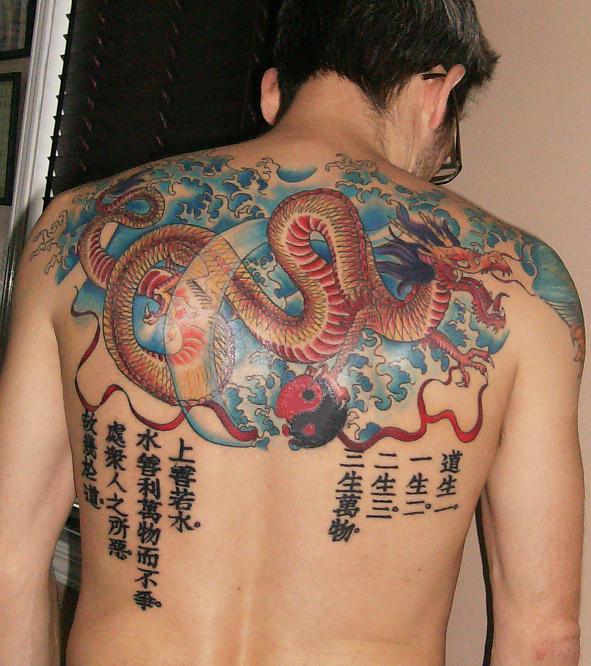
I have my entire back tattooed. It was a 25 hour ordeal.
It was painful. There was one point that I began uncontrollably shivering. My body was going into shock. But I would not use the word 'suffering' to describe this experience.


When I tested for my Black Belt in Taekwon-do, I could describe it as painful. It was a brutal three and a half hour experience that pushed me close to my physical and mental limits. (And incidentally, it was during this examination that I inadvertently stumbled across my first taste of mindfulness. I was previously aware of it, but being aware of it by definition and experiencing it are drastically different).


And finally there's childbirth. Although I have experienced childbirth twice, I cannot say I've experience the pain of it. However, my wife doesn't describe the experience as suffering. There was no suffering. Pain, yes. But suffering? No. I think it is because there is purpose and hope present. At some level I think we instinctively understand that these pains are normal and maybe even necessary.

Although I could continue on about experiences of suffering without pain, I'd rather stay away from that darkened avenue.

Pain is an unpleasant sensation.
Suffering is a mental and emotional response.
Pain is an inescapable part of life as we know it; it is inevitable.
Suffering is optional.
It is the delusional belief that we deserve to live life pain-free that is the cause of much of our suffering.

Pain and suffering are so closely related in our minds - in our beliefs - that when pain arises we usually respond immediately with resistance. We respond with resistance because we believe pain shouldn't happen to us. That belief we cling to is a source of suffering. The greater we struggle with the undeniable presence of pain, the greater our suffering. It is that belief which causes us to become delusional as it is inconsistent with reality.

Alongside our delusional denial of pain is also our denial of death. Few people really give this dreadful topic much thought. We don't want to die: in fact a great many people I know build their entire belief-system or faith upon its denial.

I really like Lin Yutang's shocking biblical interpretation of God's intention for Man's immortality in his book, "The Importance of Living" (pg. 16)
"God did not want man to live forever. This Genesis story of the reason why Adam and Eve were driven out of Eden was not that they had tasted of the Tree of Knowledge, as it popularly conceived, but the fear lest they should disobey a second time and eat of the Tree of Life and live forever.""
We were never meant to live forever and we never will. Doesn't chasing this golden dream (or red herring?) of immortality, whether it is some form of favoritism  or an earned reward of Heaven for doing or saying the right things make us little more than spiritual hedonists? I'd like to believe humanity has the potential to grow and evolve these altruistic traits without being threatened into obedience or bought with rewards. I'm not saying that a spiritual life doesn't continue after physical death. It's that any position we hold is little more than conjecture - or projection - at best. Because we choose to believe it doesn't make it true. But it does affect how we live our lives.Our compassion becomes highly suspect and conditional and maybe even self-serving. Doesn't this contribute to the suffering of the world?

In the various mindfulness traditions I think there's hope.

Suffering occurs when the mind responds negatively to the sensations it identifies as pain. The key to diminishing the suffering that we usually connect to physical pain is acceptance. Acceptance means confronting unwanted pain without hatred and especially without fear.fear. And this acceptance also means a willingness to abandon some of our beliefs. To allow room for a faithful doubt, rather than a doubtful faith.

The moment we attempt to make our beliefs fact is the moment suffering begins. It can only give birth to anger, fear, panic and disillusionment and strengthen the fetters that bind us.

I don't think there's anything wrong with having beliefs, so long as we acknowledge them for what they are and are not. (Simply beliefs, not facts).

It is when the Ego attaches itself to our beliefs that we wade into trouble.


Sunday, February 24, 2013

Paper Bags & Babies' Bellies

While attempting to practice mindfulness - especially within meditation - the idea that we are striving for is best seen in the analogy of stirred up, muddy water (our minds). If we could calm the mind, it will settle and - as with the muddy water - the mud and sediment and random thoughts will eventually settle, leaving clear water (mind).

This is much easier said than done. Most often you'll discover, the mind has a mind of its own. You  are not generating these random thoughts, something else is. It is a good habit when you become aware of your mental drifting to have some sort of centering practice to 'bring your wandering mind back'.

I have had a great amount of success with what I call my Paper Bag Technique.

~

Do you remember your elementary school days when your mother would pack your lunch every day in a brown paper bag? It is these bags that I am referring to; especially the way the square bottom would be folded up to flatten the bag.

I imagine the paper bag slowly being opened and expanded with air. This folded bottom expands and opens first and only then can the upper and rest of the bag open up. It is important that you visualize the bag's bottom downwards (as in the picture).

~

Have you even watched a sleeping baby breathe?
We tend not to breathe like babies breathe. Babies breathe with their bellies. We, as adults, tend to breathe with our chests.

I think it is because we have been taught and conditioned to do so. A big belly, for a man or woman, is generally frowned upon.
We usually try to keep our bellies tight and drawn in.


For men a muscular chest is seen as both masculine and a sign of strength.


For women a large chest is seen as being big breasted, curvy, sexy, feminine and fertile.


Whether we have large muscular chests or big breasts or not isn't really important. We can always puff out our chests when we breathe to either fake it or augment it. Expanded chests, tight bellies; that's why we breathe like this.

When meditating we need to breathe like babies; with our bellies.
Breathe in and expand your belly first and then slowly fill your chest. Exhale. Repeat. Simple.
In my mind's eye, I visualize the paper bag with my every breath.

I have found that when attempting to meditate, and when my mind wanders, this practice works well. This is simply a good breathing exercise. We tend to never breath fully or deeply enough.


Wednesday, February 20, 2013

Alcohol Substitute

Many people make a vow to abstain from alcohol, often citing religious reasons. (Often religious people might use alcohol as an issue of judgment. I know there is a tension between the Evangelical and Catholics on this issue - among others - and Muslims also come to mind.)

There was an Evangelical wedding my wife and I were invited to several years ago that was quite the experience; one we'll never forget.

No alcohol.
None.
No cash bar. No open bar. No wine on the tables, but grape juice for the toasts. Don't get me wrong. It isn't that I need alcohol to have fun. It's not that I need alcohol to celebrate. It's that there wasn't really any celebrating. Strictly controlled speeches. No music. No dancing.

It was like fun was replaced with fear.
That is the point that haunts me to this day, and has heavily affected a decision I made last summer on holiday (August 2012). I promised myself to give up drink. No, there was no event or embarrassment that initiated it. Just a point I came to in my personal journey towards solace and compassion.

However, I have zero tolerance for using this promise for any degree of attention. We all know these people. At some celebration or social event they decide to make it about their abstinence or their belief, at the passive judgement and potential guilt of others. No, that was never the purpose for me. I would have no difficulty with a glass of wine at a toast or social engagement should it merit it. (And incidentally this made me appreciate and savor the tastes more than before).

I know what you're thinking because I thought it myself. “That's not making a vow to abstain from alcohol”.

~

Maybe we should explore some traditional understandings or assumptions about 'vows'. Many of our “Western Traditions” or beliefs or religions – like the Evangelical, Catholic, or Muslim mentioned earlier – are ethical systems governed by rules. They are based on obedience to regulations and consequences. Failure or disobedience comes with moral guilt and fear of punishment. Ultimately, whether intentionally or not, it is a system of fear - and in turn - punishment. Taking a vow of alcohol abstinence in this tradition can only end in a fear of failure. There are no degrees or gradations allowed, for its purpose is not focused on personal growth or improvement, because improvement is an ongoing process, and process involves growth, and growth involves failure.

I don't believe this is spiritually healthy.


In the Mindfulness tradition the practices governing ethical behaviour are primarily concerned with shaping personal character. If one falls short of the promise, they simply take note of the shortcoming and vow to do better on the next occasion, without the feeling of incompetence or moral guilt.

This particular way of approaching ethical conduct invites the individual to act morally – not to avoid punishment (I don't run a red traffic light because I'm afraid of getting a ticket, but because I understand the danger I put myself and others in), but for the more positive and constructive purpose of refining one's character and promoting the well-being of the world (solace and compassion). This Mindfulness tradition uses neither the stick nor the carrot. (I am not given a reward for my good behaviour).

Making a vow in these two traditions involve drastically different functionalities.

~

I suppose my 'vow of alcohol abstinence' was more one of moderation and refraining from abuse. But the more I thought about it, the more I came to realize it was closer to Buddhism's 5th precept:
I shall endeavor not to consume toxins.”

Alcohol is not necessarily a poison, but it can be. However, there are a great many mind-inflicting toxins out there.

Historically, the precept to refrain from consuming toxins referred specifically to the use of alcohol, but the intent of this principle was simply to diminish the destructive effects of drunkenness. The use of alcohol can obviously affect the ability to think clearly, but alcohol isn't the only substance that can affect our ability to think clearly. Adhering to the spirit of this precept would necessarily mean becoming aware of any substance that could impair our mental and bodily functions, such as tobacco and mind-altering drugs.

Promising to observe this precept means nothing less than monitoring the things we allow into our bodies and into our minds.

Guarding our minds from intoxication and toxicity would necessarily include being aware of the kinds of information we take in. Gossip, slander, toxic people, poisonous attitudes, and some media. (Is watching Simon Cowell degrade and humiliate hopeful young artists and singers really entertainment? What does it say about you if you enjoy this?)

Religion can be a dangerous addiction.
Religiosity is a consumable toxin. And for those who would make this vow of alcohol/toxin abstinence – especially for religious reasons – I would advise them to search deeply and tread carefully.
Do not replace one with another more difficult to abstain from and near impossible to identify or be aware of. In fact, one could argue that Religiosity has a built-in system to keep its addicts blind to their affliction – fear of punishment and moral guilt. Perpetually conditioned to believe themselves undeserving and inadequate.

For me, these past six months have been yet another exercise in approaching the Mu Portal; freeing myself from the fetters that shackle and bind me.

I don't think is it overly important whether we take this 'vow' to not consume toxins, but I think it is extremely important  that we take an inventory of toxins within our daily lives. Alcohol would seem to be the lest of our worries.


(...continued on The Cleansing...)

Tuesday, September 18, 2012

The Dharma Entanglement: The Doctor-Manhattan-Syndrome

The graphic novel, Watchmen, made Time magazine's list (2005) of All Time 100 Greatest Novels to be read (and the only graphic novel to make the list, alongside the likes of J.R.R. Tolkien's Lord of the Rings, George Orwell's Animal Farm, Margaret Mitchell's Gone with the Wind, and William Golding's Lord of the Flies). Yes, it was also made into a movie in 2009, and a good one at that, but the book is still worth the read!

Watchmen takes place in an alternate universe in which our recent history is re imagined with superheros present (from the 1950's through the Vietnam War up 'til today – with the potential of an American-Soviet doomsday war looming overhead).

Nite Owl (a Batman analogue) who relies upon Owl-themed technology and gadgets.
Silk Spectre (both) were highly trained in hand-to-hand combat and martial arts.
The Comedian was more of a super soldier in the sense of the arsenal of weapons he seemed to enjoy using.
Ozymandias is the zenith of the human potential – using 100% of his brain and having achieved mastery over his mind and body.
Rorschach, a masked vigilante, and nighttime crime fighter whose sense of right and wrong are black-and-white in a gray coloured world.

The one commonality we find is that these superheros do not have super powers... and then we have Dr. Manhattan. A glowing blue skinned deity with – as both the character himself and the reader slowly discover – near omnipotent powers.

As Dr. Manhattan's powers grow, the more 'secrets of the universe' he becomes aware of (none of which are openly shared with the reader unfortunately), the more and more distant and disconnected to his fellow human beings he becomes, to the point where he would seem to have not so much achieved Enlightenment, but passed into the realm of becoming a god; Alien and disconnected to the human condition. He can no longer relate and eventually abandons humanity and leaves Earth to pursue what we can only imagine to be his own interests or further enlightenment.

There's a great line in the movie A Fish Called Wanda where Wanda (Jamie Lee Curtis) corrects her dullard partner in crime Otto (Kevin Kline),


”Let me correct you on a few things... The central message of Buddhism is not "Every man for himself!"”
I call this the Doctor-Manhattan-Syndrome: Buddhism gone terribly wrong.(And let's not kid ourselves. It isn't solely restricted to Buddhism. We've all seen our fair share of the Doctor-Manhattan-Syndrome run amok in Christian circles as well. Who's saved and who isn't and a hedonistic obsession for self-salvation. The other side of this coin is the counterfeit compassion of attempting to 'save others' through prosytlization to the point where either people become projects – dehumanized – or bragging rights to how many people one has 'saved'. But I digress).

The Doctor-Manhattan-Syndrome is an exercise in missing the point, or totally becoming self-serving in our pursuit of (self) enlightenment or (self) salvation.

Interestingly, this "perfected" (if we can really call it that) state of Holistic Solace could be synonymous with what many might mistakenly understand Enlightenment to be. Because alone, it is incomplete and self-serving. This Holistic Solace, this state of "Enlightenment", this Doctor-Manhattan-Syndrome would be lacking in one's ability to discern, absorb, and understand truth and have critical deficiencies in Compassion if not completely separated from it.

The Doctor-Manhattan-Syndrome would be the Buddha's enlightenment under the Bodhi Tree and no more. He would have simply become enlightened and found no need to share this - let alone teach - to anyone else.

I believe when we focus our efforts on improving our mental and spiritual solace(s) alongside striving to find a better and more harmonious physical health, we slowly, surely, and gradually move towards a better and 'higher' soter state. Being 'healed' (salus), but more accurately, being made whole; unified. But these 'stages'; these areas of healing and unification and growth are all inner, private, and personal. By no means must we be perfect in these self-improvement endeavors, but we must be 'whole' enough (soter) to see clearly. We must be 'healed' enough (salus) to reach out and help others.

The-Doctor-Manhattan-Syndrome is when the effort is successful but our vision remains deluded and we can see no need or desire or purpose for compassion. It is an empty enlightenment.

Solace and Compassion are entangled by Dharma.


Monday, September 3, 2012

The Dharma Entanglement: Introduction


We, the human species are by nature gregarious; social creatures. We live in communities. I also believe that is why we are religious; or at least have a tendency towards it. I believe we are all religionists of one flavour or another.

Maybe I shouldn't use the word “religion”. It can cause some confusion. 'Religion' often implies a necessary belief in God or gods. It doesn't need to. I would count Atheism as a 'religion' for the purposes of this discussion. Maybe a better term we should use is Belief-System. Yes, we'll save the term 'religion' for the disease of religiosity...

Belief-Systems

Because we are gregarious and because we must live amongst our fellow man – and with ourselves – I think this is the reason we all have and follow some sort of Belief-System. Some of us can happily name and identify which Belief-System we belong to and follow. Some of us cannot. Some of us think we can but in reality don't know.

Our ability to acknowledge which one Belief-System we belong to has no bearing of the fact that we all do. There are many of us who follow a Belief-System that has no official recognized status, or even some who follow an unnamed, poor, and damaging Belief-System. But the fact is we follow one or some.

Which, ultimately, brings us to an important question. What should we expect our Belief-System to do for us? What purpose should it serve and what purpose does it serve?
"Western philosophy, having little connection with everyday living, is (to this observer, at least) comparatively egocentric and impractical, with much Arguing and Theorizing, and much bounding back and forth across the intellectual landscape.

"Western philosophy has become the domain of pipe-smoking, tweed-suited college professors (who may profess it but not necessarily practice it) and hypercerebral students who, for all their intelligence, often seem to have a hard time washing their clothes or repairing the lawn mower.

"In the East generally... philosophy has always been considered of no value unless it can be, and is, applied in one's daily life.

"Out of the "Hundred Schools" of Chinese philosophy, only two - Confucianism and Taoism - have survived. They have lasted through thousands of years because they have proven the most Useful."

Benjamin Hoff, "The Te of Piglet"
What should we expect our Belief-Systems to do?
It's funny because this was the final question I came to during my 25 year 'travels' as a spiritual sojourner. An unfortunate event triggered this journey for me and began my searching for answers. - And boy did I find answers! - But that wasn't what made this journey so difficult and so challenging. Unbeknown to me, it wasn't answers that I should have been searching for, but questions. The challenge was that the questions, over the years,  kept changing.

I'm one to believe there's nothing new under the sun. I'm not going to present the things I learned as ideas I came up with or created or invented, but rather as concepts I discovered and stumbled upon. Men thousands of years ago – much more educated and wiser than I'll ever be – have summoned some of the concepts and thoughts that I desperately struggle with up in a single word. No, there is nothing new under the sun, least of all what I write here.

So, what should we expect and demand of our Belief-Systems? What should we demand of our religions? And when they fail to provide these expectations and demands are we ready and willing to eject them either wholesale or partially?

(It was late February 2012 when I had to submit my written thesis for my Black Belt examination in Taekwon-do. It was entitled “Solace & Compassion” and it was at that point when the purpose of most (all?) Belief-Systems solidified to me).

I should think our Belief-Systems and our religions should provide us three things and enjoy the byproduct of a fourth.

1) It should not provide us truth. It should provide us with the methods and tools to acquire, accept, and manage truth.
2) It should provide us with direction and guidance to Solace; inner peace (be it physical, mental, spiritual, or all three).
3) It should teach, foster, and help nurture Compassion for others. (We should be watchful that it doesn't pretend and offer a counterfeit compassion; pity).

A byproduct of these three points is community. And as gregarious creatures by nature – like or not – we live in communities. Families, friends, social circles, clubs, gangs, churches, unions, the list goes on. Not all communities are good; we must live in them never-the-less. But we can make good communities.

It is important to understand these three points and how they are intertwined with one another. Without Solace one is divided and conflicted. Without some degree of Solace caring for others is a near impossibility. To a certain degree, Compassion becomes the fruit of Solace. But yet so too can the opposite be true. Genuinely helping another – even a single kind act – can bring peace of mind and a sense of balance and harmony.

Dharma

I wholeheartedly believe how we view, accept, and acquire truth heavily influences both our Solace and Compassion. If we are set in our ways and in what we hold to be true, regardless of what our experiences show us or how reality is, we will repeatedly come into conflict with those “facts” of reality. If we cannot or will not change to accommodate new or corrected truths then it becomes increasingly more difficult to live at peace with the world and the people around us. A Belief-System or religion that teaches us specific and erroneous truths rather than how to find truths can only undermine us.

I find it interesting those people who seem to feel the need to argue and defend the truth (often their truth). Truth needs no defending. It simply is. It should be self-revealing and obvious.

I call this 'Dharma'. This is not Dharma in the Buddhist sense of the three gems or the three treasures. This is not the Buddhist teachings that indoctrinates one into Buddhism. This 'Dharma' is simply the self-evidential truth, but more specifically our openness to being aware of it and accepting it. It is a reflection of ourselves more than the truth in question.

Dharma is not truth itself, but one's understanding of and methods of acquiring, accepting, and managing the truth...
...and Solace and Compassion are entangled by Dharma.

This is what I call ”The Dharma Entanglement”. This is the goal and purpose of a Belief-System I have come to believe and pursue.


Below is a map, a flowchart of sorts, showing the paths and conclusions I have come to and discovered. Although it shows the various paths and conclusions I have encountered it is extremely generalized and extremely summerized.  Yes, it will look like I am painting with a very broad brush. It may even appear judgmental, but please understand, years were spent (wasted?) following (not studying) these numerous and meandering paths. It is by no means meant to be a universal truth, but only one I have experienced. (I had been extremely hesitant in using this Excel-chart. It is far too 'mathematical'; far too black and white. It frightens and concerns me that it gives the wrong message that this entire process is little more than an equation, which it is anything but. Each and every point on this chart could easily be a lengthy post onto its own, and in fact, some of them are).


(The chart itself is a link to the Excel-chart proper and this chart has numerous links to various topics and articles).

When I had began this blogsite, The Woven, the idea was to explore and hopefully discover the commonalities between Judaism, Christianity, and Islam. But like I mentioned earlier, the challenge was not in the answers I discovered, but that the questions kept changing. What it ended up becoming was an exploration of Atheism, Judaism, Christianity, Islam, Taoism, Buddhism, and Gnosticism.

The Mu Portal

Although there could be many possible paths to the Dharma Entanglement, ultimately I believe “Mu” is a necessary gateway to escape the shackles of Religiosity and enjoy the emancipation of Spirituality. (Only then can Spiritual Solace be realized, cultivated, and nurtured).


Mu is Japanese for “not” often used as a prefix, but can stand alone, simply as 'not'. It can mean to “unask the question", suggesting that the problem does not lie within the answer (there is no correct answer), but within the question itself. The problem needs to be approached from another point of view.

I have found many monotheists (as well as many Atheists) lack a healthy sense of Doubt, and suffer from an addiction to Certainty. And when we fall victim to the Certainty Addiction everything becomes a matter of knowing and fact and proving one's beliefs. Faith dies. Truth takes a back seat to being Right. Thus enters the hidden and silent inner conflict. Combine this addiction with inner conflict and the monotheist's concept (fear) of Damnation and their Solace's destruction is complete.

”Mu” (regardless of which avenue one arrives here or even by which name one recognizes it as) is the ability of simply 'letting go' and be at peace with not-knowing. (And shortly we will discuss the value Gnosticism can provide to approaching this gateway and better understanding of it through symbolism). Allowing a Faithful Doubt (rather than a Doubtful Faith) and living at peace with its mystery. Something many religious people (especially institutional religions) struggle with.

I think this gateway is critical to one's spiritual journey. Without it, it is simply stagnation. Growth becomes impossible. The entrapment of religiosity remains unbroken.

Solace(s)

There must be a great many paths to mental Solace; clarity of mind. I can only speak of my own experiences. For me it came through Guk-gi (“Self-Control”) and Jung-Joong-Dong (”stillness in motion” meditation), both from Traditional Taekwon-do's Jungshin Sooyang (“Moral Culture” - the base and underlying philosophy and principal behind Traditional Taekwon-do).

Physical Solace, is really little more than keeping your body healthy and balanced. I have began this process by certain dietary changes, being attended to by an acupuncturist and Traditional Chinese Medicine Doctor, and being physically active (In my case, practicing Taekwon-do). I take a daily dose of Bee Pollen to help build and maintain my immune system and I have recently chosen to give up alcohol (Aug. 20/12).

These three forms of Solace are a potentially long process and I do not want to give the idea that I am anywhere but at the beginning of this process. But one thing is clear. At least I have a 'map', so to speak – a direction.

"Holistic Solace, Soter, Salus"
I believe these three ideas of finding peace or a balance within oneself can be cumulative into something truly marvelous. I'm at a loss as to what it may be called. Holistic Solace; Soter; Salus (Salvation? Enlightenment?) It needs to be explored as to what it is, but it is part of this Dharma Entanglement; intrinsically tied into Dharma and Compassion. Clearly this "Holistic Solace/Soter/Salus" needs to be better fleshed out. As of this moment, I'll have to leave that concept for another time.

Gnosticism

Of the seven 'faiths' I have been looking at - Atheism, Judaism, Christianity, Islam, Taoism, Buddhism, and – Gnosticism, must be the most peculiar of the lot.

There are hidden pearls of wisdom within it. There are also aspects of it present within many other Belief-Systems. It might at times be best viewed as fragmented. What complicates this further is that there was never a single group that we can refer to as 'the Gnostics' (capital 'G'). They were numerous, varied, and diverse. They existed in different times, different cultures, and different religions. It's surprising that we even use an umbrella term like Gnosticism for this entire group. But rather than focus on the underlying definition and traits that unify these varied groups, I prefer to focus on the bits and pieces worth extracting and keeping; those pearls of wisdom that we would do well to pay heed to, and have helped me on my way.

One strong feature in Gnosticism is their understanding of myth (mythos). It would seem at times deliberately opposed to historicity and purposely to combat literalism.

I particularly found values in Valentinus' gnosticism, a Christian Gnosticism. In his reinterpretation of the Genesis story of the Garden of Eden, we find a story through metaphor of an inner struggle to escape the oppressive slavery of Religion and suggestions of Religiosity's petty and insecure god.

The Garden of Eden is not paradise, but the Cage of Religiosity. The Serpent is not Satan, but Sophia - God the Mother - the Holy Spirit - showing the path (or the way) to the Mu Portal. The Fruit of the Tree of Knowledge is not Death, but to pass through the Mu Portal (freedom from Religiosity - emancipation), and only then can the Fruit of the Tree of Life be attained (The Fruit of the Tree of Life being the Cosmic Christ (Christ the Revealer rather than the Redeemer), Sophia, and Abba (literally "Daddy" in Hebrew, as opposed to the God of Eden, Yahweh/T'ien), all understood as metaphor, not literal history.

And it is here that we find an example of Gnosticism's strongest points.
But allow me to jump to a slight tangent for a moment:

T'ien, Yahweh, & Sophia

The Confucianist's concept of a Heavenly Power shared a certain resemblance to the Old Testament image of God. The Confucianists called it T'ien - “Sky”, “heaven”, “Supreme Ruler”. T'ien was seen as masculine and often ferocious. It needed to be appeased with sacrifices and rituals. It took sides. It granted authority. It transferred authority and sovereignty directly to the Emperor, the Son of Heaven.

T'ien was said to grant material prosperity as rewards (thus the Confucianist equation of wealth with goodness).

T'ien was considered something to fear rather than love, hence the emphasis on unquestioning obedience and loyalty and the absence of terms such as Compassion.

The Taoists on the other hand, saw Heavenly Power as both masculine and feminine, as symbolized by the Taoist's Yin-Yang symbol.

In the natural world however, Taoists saw it as mostly feminine in its actions, what Lao-Tsu called “The Mother of Ten Thousand Things”.

It was gentle like flowing water. It was humble and generous, like a fertile valley, feeding all who come to it. It was hidden, subtle, and mysterious. It took no sides, it wasn't tribal, and granted no authority. It could not be influenced or manipulated or appeased by sacrifices or rituals.

Like the dichotomy between the Confucianist and Taoist view of Heavenly Power, the Gnostics (Valentinus especially) revered and worshiped Sophia - the divine feminine.

Sophia - God's wisdom personified. Possibly the third aspect of the Holy Trinity itself; God the Mother.

The parallel between the Confucianist's masculine and ego-driven (insecure?) Heavenly Power, T'ien, and the Old Testament's masculine and blood-thirsty tribal God, Yahweh, is uncanny.
This projected God even carries itself forward into modern day Christianity with certain adherents' refusal to acknowledge anything but a masculine God, down to the Prosperity Gospel, Confucianist's twin image of wealth being a sign of goodness.

The Gnostic's divine feminine - Sophia - is the missing piece. Like the Taoists understanding of the feminine power active in the world around us, Sophia is the mother of all things. Gentle like flowing water, but never-the-less all-powerful like water. Even the stone cliffs are eroded away by the ocean. She is humble and non-egotistic. Generous and accepting all who come to her. She is the God of non-tribalism as she desires no sacrifices and cannot be influenced, manipulated, and needs no appeasement.

These factors, the wisdom of gnosticism, can be an equally valid path to the gateway of Mu; an escape from the bondage of Religiosity; literalism, legalism, an addiction to certainty, tribalism, and into the freedom of spirituality.

But the point here isn't to convince you of a female God. That would only lead you astray, making you fall victim to the addiction of certainty but only of a different flavour. The point is that we do not and cannot know God fully. God cannot be simply placed within a convenient box, categorized or clearly defined. If we believe we can do this, then the God we believe in is nothing more than a personal projection; an illusion. It is an act of supreme arrogance. And this applies equally to the Atheist as well. You do not and cannot know of God's non-existence. You cannot know for certain of God's theistic or atheistic natures. You can only choose to believe in it. To do anything else is arrogance.

I think in the opening verses of the Tao Te Ching, Lao-Tsu put it best, ”The Tao that can be named is not the true Tao”.

Which is why I believe and have listed Agnosticism as a potential path to Mu. Because a healthy agnosticism embraces Doubt as part of their faith. There are some “theological” issues you must be at peace with simply not knowing.

We can see the crossover Gnosticism shares with Taoism.

I know many people who would place Buddhism as Atheistic, but I think that's in error. Some Buddhists are theists of one sort or another. Some Buddhists are atheists. But ultimately I think Buddhism doesn't address the issue. It simply doesn't ask the question because it cannot honestly be answered beyond the statement, ”I believe...”

And for those who would pass through The Mu Gateway, ”belief” must not be abandoned, but must be acknowledged for only what it is. A choice but not necessarily fact. Belief but not necessarily truth.

I remember reading John Hick's God Has Many Names in 2008. He was speaking of interfaith discussions and pluralism.

He held hope for Judaism, Christianity, Islam (monotheistic religions) and Hinduism, but saw potential pitfalls and challenges with non-theistic religions like Buddhism, Taoism, other Eastern religions, and Humanism.

I think this demonstrates the problem quite well. Is the topic and goal at hand to find consensus and common ground on the issue of theism? Is it really all a Question of Theism? (Yes, I admit, many people will make it an issue of exclusively Theism), but is that the entire purpose and goal of religion and Belief-Systems? Are we really only concerned with being Right? Are we attempting once again to defend a truth which needs no defending?

Arguing and proving and defining God? Or is it only the shallow and spiritual hedonistic self-serving pursuit of Salvation or Spiritual Enlightenment?
No, I don't believe that.
Solace and Compassion. Plain and simple.


Thursday, March 8, 2012

The Conundrum of the Unconditional

The Crux of Christianity


In Rob Bell's book - Love Wins - he spells out painfully and simply the problem (as far as I'm concerned, the real good news) with Christianity – that of an unconditional grace.
“And that question raises another question. If the message of Jesus is that God is offering the free gift of eternal life through him – a gift we cannot earn by our own efforts, works, or good deeds – and all we have to do is accept and confess and believe, aren't those verbs?

"And aren't verbs actions?

"Accepting, confessing, believing – those are things we do.

"Does that mean, then, that going to heaven is dependent on something I do?

"How is any of that grace?
How is that a gift?
How is that good news?

"Isn't that what Christians have always claimed set their religion apart – that is wasn't, in the end, a religion at all – that you don't have to do anything, because God has already done it through Jesus?”
Rob Bell, Love Wins, page 11
This is Unconditional Grace.
This is the conundrum of the unconditional.

This is the crux of Christianity.

Ultimately, this only points out that we have a simple choice.
Either Christianity has always been flawed and little more than just another religion not necessarily worth keeping, or that what we have today is a hijacked corruption of what its founder(s?) intended.

There's no doubt that this conundrum of the unconditional, has and is causing a lot of rumbling and controversy in church circles. There are few acceptable options to the church... and this conundrum cannot simply be written off.
 

If they truly loved what they say they do, then they would follow it. This conundrum, this crux becomes a delusional mirror.


The Conundrum of the Unconditional

I believe a certain Christian view of Judaism (as a symbol, not necessarily the faith itself; possibly the Pharisees themselves) represents the Law, Legalism and the trap of legalistic religion – all religions; all religiosity in its numerous forms.

I believe Christianity with its unique concept of Unconditional Grace (which I believe Christendom and Churchianity will never fully understand nor accept or embrace), not only frees us from the constraints and shackles of Legalism, but also signifies the death of Religion itself in its most absolute sense.


Christianity cannot be a replacement for all religion. (Not even a benevolent once-and-for-all one). This makes Christianity a process. This makes Christianity a transitory state; something that one evolves through and out of, but extremely important and valuable for what it is. Maybe even globally necessary.


Once we realize that there is nothing we can do or need to do to “get right” with our God (or “gods”) - that we don't need to gain forgiveness or appease them because that acceptance, that forgiveness, that “salvation” was always there. Once we discover that innate and inherent unconditional grace I believe the only question left is, “Now what?"

The more and more I learn of it, I believe Buddhism might be a continuation of that question. Buddhism isn't the destination but the “how to” response. It can be a practical way to living with oneself and with others (or for others). (But let us be mindful, Buddhism itself is not immune to religiosity).

I realize that many Trapped-Christians believe God and only God can help us – never the actions or deeds of our own doing. I think these Trapped-Christians misunderstand this as Grace. (But it's conditional, and conditional grace is no grace at all. If it's conditional it is that path back to the Law, Legalism and Religiosity. That's why they are trapped. It's a perpetual circle)....  maybe I should stop calling them Trapped-Christians and start calling them shackled, or fettered; or simply Trapped. For they are by no means exclusively Christian. They are simply victims of religiosity.

The Buddha said, 'To be attached to a certain view and to look down upon other views as inferior – this the wise call a fetter.'” From the Sutta Nipata, translated by K.R. Norman.

I realize that many of those Trapped also believe that Buddhism is some sort of self-help guide to earning one's salvation. A sort of “Who-needs God? I-can-do-it-myself” scheme. I think many (some?) believe, the Buddhists believe, that enlightened state of Nirvana is supposed to be synonymous and interchangeable with Heaven. They are not synonymous.

Clearly, this Western modern day Buddhism - this new opening petal of the Dharma lotus - needs to be better explored, better understood, better interpreted, and "unpackaged".


"The three Jewels of Buddhism are 1) the Buddha, 2) Dharma, and 3) Sangha.
"I don't believe this concept belongs exclusively to the religion of Buddhism. I believe Buddhism only expresses it through its own particular paradigm. In fact, I think these 3 treasures - these three jewels - are universal truths. I see these as three Lotuses.
“Nirvana shares one quality with the lotus. As the lotus is untainted by water, so is Nirvana unstained by all the defilements”.
"The first jewel – the Buddha – does not necessarily have to mean Siddhartha Gautama himself, but, in all likelihood, might refer to the awakened nature of all beings. I see this as extremely similar to the martial art's Taekwon-do's tenet Guk-gi (Self-Control). (And Solace is a fruit of Guk-gi).

"The second Jewel, Dharma, is the teaching, but let's not take this too literally. This doesn't have to mean Buddhism's teaching(s). We shouldn't become frightened that to accept this Dharma means a path away from whatever belief or religion we currently belong to. No, I think this treasure - this universal truth - is simply being open to learning. I take Dharma as taking and accepting truth whenever and wherever we find it. (In fact, this might very well fly in the face of propositional truth [fundamentalism?]). I see this Dharma as akin to what is borrowed from the Chinese -do, or Dao, or possibly Tao, meaning the way or path or route to something, and that something is the fundamental nature of the universe.


"The Sangha in Buddhism generally refers to the Buddhist's community itself. But the further we take this concept the larger one's Sangha becomes. On its largest level we are faced with the global community as our own, and I think this is a perfect place for us to reflect on the underlying concept of Compassion. I think it is important not to mistaken, or force a necessary interpretation, of this Sangha as meaning a specific and exclusive religious body of followers. I take this Sangha concept as being boundless and without boarders.
"I believe the most valued truth that we can discover is that of Solace and Compassion.
"And Solace and Compassion are entangled by Dharma." (Excerpt from The Three Lotuses).

Sunday, December 18, 2011

Hook-Line-and-Sinker, or Through-the-Looking-Glass?

Old Highway 17

I have a vague memory of the first time I encountered God. I shouldn't say “God” for at that time in my life I held absolutely no concept of the divine.

“God's” a funny word. We should really be careful when we use that word. It means so many things to so many people. To a child it's an old man with white hair and beard sitting on a cloud. To some it's an impersonal entity or force running or guiding the universe. To others it's a universal-mind itself. To many God has been imbued with a personality - “personhood”. I suppose this is necessary for our very finite minds to wrap themselves around a very infinite being – the Being. The problem with this is that we also tend to pass on all too human traits. Jealousy, anger, Tribalism, Nationalism, Hatred, let alone using God as a tool to further our own agendas and ends.

Allow me to just say that I can remember the first time I encountered something other.

My mom and dad and I were on a car ride. It was long before my sister was born – during that long chapter in my life as the only child.

I can remember that I had absolutely no sense of time-reference. Not days of the week, not actual dates (numbers), not even larger time-frames, like Grade-1, or Grade-2. It must have been pre-kindergarten so I'll put myself as being under 4 years old; probably 3.

I can remember the car traveling what felt like west-bound (not from my childhood memory, but from how I remember it as an adult), but towards to main-city of Ottawa with a body of water (river?) on my right and rocky fields to my left. (For any locals, I figure it was Old Highway 17 between Ottawa and Wendover).


We stopped at what I can only remember as a sort of rocky quarry. I can't remember any machinery or equipment so it probably was more of a outcrop of rocks than a quarry proper, but there was definitely what appeared to be a sharp (cut stone) wall behind, with a litter of stones and rocks everywhere.

I remember my goal was to find and collect rocks! (Not any sort of special rocks. Just rocks!) It felt like I must have been miles away from where my parents were. I was busy 'exploring', but in all likelihood, I'm sure I wasn't far from them.

And then, suddenly, I became aware of a presence. Like someone or something accompanying me. Friendly, warm, caring. I never questioned whether it might have been my imagination or not, I think I was simply too young. But that memory has always stuck with me.

Ultimately, it was the genesis of my searching out God.

However, simple and powerful that one 'encounter' with the unknown was, it wasn't my any means the only one.

I have had several paradigm-shattering encounters and experiences in my life. This earliest one in the quarry was the first. Then there was my dream of The Storm in '83. My mother's death in '87. My precognitive dreams the led to my wife and marriage in '90; the end of a 10-year exile from God in '97. The birth of my autistic son and an experience 20 years later at my mother's grave.

All of these experiences have feed this quest and journey and search.

~

Allow me to switch gears – change topics. I think I might go at this from a different perspective.

I have never been one for institutional religions and I know by some people, I have been accused of taking the easy path; the path of least resistance.

I have been told by some that being an adherent to a particular church or temple (or religion or even community) requires a commitment not unlike a relationship, or even a marriage. By these same people I have also been told that I fail to make this sort of commitment. I should actually be insulted (most specifically because of the comment to failing to commit to a community) because – really – what I am being accused of is a lack of loyalty, and loyalty is something I do not lack.

I have recently reflected upon, not so much my experiences themselves, but upon my attempts to search out the truth behind them, and what I discovered.

Often times, I so wanted the truth to be enlightening, to lift all worry and anxiety and give me an overwhelming sense of peace, that I would be more than willing to suspend my disbelieve, to suspend my cold analytical eye. And sometimes, briefly, it would work.

As my searching brought me into more and more contact with more and more people and others' experiences my understanding of God, my belief of God, grew and changed. Ideas and images that I struggled with died and newer, better ones came into existence. Certain problems with the idea of God ceased to be issues once viewed from a different point of view. Spiritual maturity? Possibly.

I have often wondered whether I subject myself to believing something hook-line-and-sinker. (Because when I think back to numerous experiences and involvements with various groups it's kind of embarrassing. My, how I've changed). Am I just lost soul, floating from one to another faith, desperately embracing everything or anything like a drowning man clings to anything thrown to him? Maybe my naysayers are right.

I came to realize something that I eventually called -ologies.

You know, as in Archeology. Biology. The science of, or the study of any said topic.

However, it was with Theology that this method fell apart in my opinion.

As a biologist studying a paramecium under a microscope this same analogy absolutely could not work – or at least would fail miserably – in the realm of theology.


You could not objectively observe and study God from a distance. (And on a side note, I think that is what's wrong with so many churches, religions, and theologists today).

In this particular “science” you must go through the looking glass. The biologist would need to use his microscope as a slide to sit side-by-side with the paramecium he is studying (and hope it doesn't mistaken him as a food source!)

You cannot 'study' God. You experience it. The act of “studying” God is to change you. It doesn't work any other way. Or so I thought.

I don't think I take the path of least resistance. In fact, I've come to the conclusion that 'how' I pursue my searching for this encounter I had as a 3-year old puts me in danger.

I think what I 'do' is not so much like a lost soul adrift, nor like a drowning man desperately clinging to absolutely anything thrown to him, but more honest and more akin to traveling through the looking glass. Putting myself 'out-there' and allowing myself to be affected and changed by my encounters. Not objective and distant.

But the more and more I've practiced this, the more and more I realized that it wasn't God that I was encountering and experiencing, but people. It was people's hopes and dreams and ideas, and projections that shaped what we hope God is. (And even what God isn't in the case of Atheists).

Broken China

I've realized that I am a potter.

I've spend most of my life inadvertently making theological pottery. Beautiful China if you will.


I've also realized that God has spend most of his life breaking it.

So, my question is really, do I, as a spiritual sojourner, indiscriminately swallow numerous 'truths' hook-line-and-sinker, or do I practice going-through-the-looking-glass? I have found precious few brave enough to travel down this path. Allowing oneself to be changed is a scary thing.

Path of least resistance? I think not.

Wednesday, October 12, 2011

A Cure for Lust

What do we look to religion for?
Why do we seek it out?
To some, I’m sure, it's in search of the truth. But I've learned 'religious truth' is an ambiguous, fickle, and tricky thing at the best of times, with a tendency to become more subjective and righteous than anything else. (And I would include Atheism within this umbrella, 'religious' definition). To some (I hope a minority) this subjective truth and righteousness, unfortunately, is exactly what they seek.

I should like to believe that we look to Spirituality in hopes of learning and better understanding Compassion towards others and Solace for ourselves. To find peace with the world around us and be at peace with ourselves.

Solace. Although in times past I am sure I would not have been able to successfully articulate it, it was what I've spend decades seeking and searching for.

I have written on how Christianity has failed me, but maybe it was I who have failed Christianity's test. Maybe I have never been baptized by Fire, by the Holy Spirit. Maybe it is I who has never successfully been born again. Baptized through Catholicism but never Confirmed, maybe I truly am not a part of the Body, but apart from it. Maybe at one point in my life the cleansing fires of the Holy Spirit washed over me, measured me, and found me wanting... My point being this isn't about pointing the finger at Christianity but simply that it hasn't 'worked' for me.

I think the three darkest demons I have wrestled and struggled with have been Fear, Anger, and Lust.
Capital “F” Fear. Not so much being scared or afraid of something or someone, but Fear as in Worry, Anxiety, Dread. The kind of worry and fear that consumes your Perpetual Now and obliterates your tomorrow. The kind of fear that controls your ability to make decisions for yourself.

~

I've never been sure exactly how to label the second; Anger or Rage.
A distinction should be made between righteous anger – anger one feels at an injustice – vs. blind, out of control anger; rage. When rational thought evades you. When it is the anger, the rage that is calling the shots.

I am by no means pretentious and I have no intention to give the false impression that I have successfully and permanently purged them. There are still moments when I battle them. However, I have through my decades of searching, through various 'methodologies' and 'religions' and spiritual paths and avenues found control, peace, and solace. Primarily through – believe it or not – martial arts. (Taekwon-do to be exact. I've written a blog on it. Tattoo: Solace in Pain. And don't kid yourself into believing that a martial art is all about combat and fighting an opponent).

~

...but Lust is another demon. When I say Lust I am referring to Lust of the sexual kind. (Truth be know, I have never really suffered from coveting material goods and 'stuff').
The church, Catholicism, Christianity, and Christ have in every method and way failed to offer succor. The closest I've come was the realization – or maybe it's better and more accurate for me to say, acceptance, of God, as the Holy Spirit, as most definitely female. “God the Mother”. Sophia. The divine feminine Catholicism sees in the Virgin Mary (not Mariolatry).

Just use your innate ability of Imagination (as opposed to 'make-believe') and pray and confess to a female God. It is a drastically different and refreshing experience.

But even this only succeeded temporarily to suppress Lust, not battle it.

It was only recently, through a serious of coincidences, that I came across a simple Buddhist mediation. A simply Buddhist method of combating Lust that has knocked it flat on its ass. (No, this isn't a story about religious conversion or proselytism. I'd have to definitely be something first to convert to another, wouldn't I?)

It begins by sitting cross legged, preferably on a pillow or something soft. Then, remove “counterproductive currents of energy” or “airs” or “winds”, through 9 inhalations and exhalations.
(I know this part might sound a little bit silly, but bear with me).
First, inhale deeply through your right nostril by pressing the left nostril closed with your left thumb; then release the left nostril and press your right nostril closed with your left middle finger, exhaling through the left nostril. Do this three times.
After that, inhale deeply through the left nostril by continuing to press the right nostril closed with your left middle finger; then release the right nostril and press your left nostril closed with your left thumb, exhaling through the right nostril. Do this three times.
Finally place your left hand back on your lap beneath your right hand, both palms up with your thumbs touching, forming a triangle. Then inhale deeply through both nostrils and exhale through both nostrils. Do this three times.
Then I conjure an image of a Lustful object of desire. But now, meditate and contemplate on their body, from the top of her head to the soles of her feet. Skin, flesh, blood, bone, marrow, urine, feces, etc. Focus on her hair, but her removed hair, like clumps you might find on a hair salon's floor or in a bathtub's drain. Finger and toe nail clippings. (This isn't for the faint of heart). Then I focus on the body's decaying and decomposing. The soft subtle skin being quite literally stripped from the body through its disintegration. Its liquids spilling out. (I've even had moments when my mind meandered on its own and animated this corpse into some sort of zombie horror)
… and I think you get the idea. Lust is the last thought on your mind. And no, I don't enjoy this, and yes, I find this exercise extremely disturbing.

I have since “streamlined” this method over time down to a single simple image. A tiny statue of a skull carved out of stone and I can summon this image into sharp focus in my mind's eye – usually – without going through the meditative process I previously described, if needs be. Its quicker that way; more practical and useful.

In fact, I use 3 images (3 tiny statues), one for each Fear, Anger, and Lust.
So far, so good. I can't complain.

I'd be interested in hearing how some of you deal with these issues – Fear, Anger, Lust – or whatever you may struggle with and successful methods.
But please, success stories only. I've heard my fair share of BS over the years, ranging from ”When I get lustful thoughts, I read my bible”, to ”I never suffer from fear or worry since I've been born again”.
… ya... okay.

I like to believe spirituality – like truth – is progressive and cumulative; it grows and evolves and expands. For those of us on this path, it makes us spiritual sojourners.

What's your story?