Wednesday, July 24, 2013

Wolves and Meditation


Funny thing meditation. Basically, it is nothing but simply sitting down, doing nothing, and being aware.
By strictest definition, it's nearly pointless. Yet that pointlessness make it a radical act as it totally flies in the face of what the world demands of us. The paradox is that this radical act of stopping, doing nothing, and just being mindful can be the most transformative, healing, and positive thing we could ever do... paying attention.

Only the items I notice shape my mind.
Ultimately, what we allow ourselves to notice literally determines our experiences. Attention determines our degree of awareness with our ordinary experiences and shapes the world around us.

Our level of awareness determines the content and quality of our lives.

There's an old Native American story.
A grandfather tells a story to his grandson, "I have two wolves fighting in my heart. One wolf is vengeful, fearful, envious, resentful, deceitful. The other wolf is loving, compassionate, generous, truthful, and serene."
The grandson asks which wolf will win the fight.
The grandfather answers, "The one I feed."


However, if we refuse to deal with or acknowledge what's difficult and painful - ignoring it; pretending it doesn't exist - whatever we neglect withers and retreats below our consciousness, where it may still affect our lives. In a twisted and perverse way, ignoring the painful and the difficult is just another way of feeding the wolf. So it is not only a simple matter of which one we focus on.  Meditation brings us all human experiences and all parts of ourselves - to be aware of both wolves.

Wednesday, July 17, 2013

Tribal Identities

I believe mankind has within it the potential to make a giant evolutionary leap forward - possible into what some might call the Noosphere - and evolve past our tribal condition. But I think this needs some careful thought and introspection.

All great evolutionary leaps and bounds have typically had a catalyst. There was a time I thought humanity needed that catalyst, that 'push' to abandon tribalism and unify. Movies, TV, literature and culture would teach us that a unified threat would do it; like an alien invasion of Earth for example.
...but this isn't the evolutionary jump we're dealing with here. This is just another - granted larger - definition of 'tribe'.

I suspect that we are instinctively hardwired towards tribalism. It's a survival trait that we need - or possibly - needed.

I'm not convinced we still need it.
Although I am convinced that tribalism is alive and well.

...but what draws us to it? Ultimately I think it is identity and our need for it. We create and build our identity (both personal and corporate) from our 'tribes', don't we?

In this multi-billion dollar new age industry of online multiplayer, first-person video games we belong to a team - red team, blue team - it matters little.

Another popular, fun, and entertaining game is Magic, The Gathering.
We can affiliate ourselves with various fictional groups and guilds: The Azorius Senate, House Dimir, the Gruul Clans - all with their own pins, T-shirts, and paraphernalia should we so choose to engage and associate ourselves with one tribe or another. It's all fun.

Too juvenile for you?  Alright. Let's mature and 'grow up' a little then. What about hockey jerseys? Loyalty to one's sports team, be it hockey, American football (...or baseball... or basketball), or European Soccer. It's odd that the degree of seriousness and fanaticism matures along with its "non-juvenile audience".


It provides us with our need for identity (at least temporarily and superficially).

This isn't restricted to our games and recreation and entertainment only. In fact, the more grown-up or serious or important we can make our tribal corporate identities appear, the more 'real' and important our tribes become.

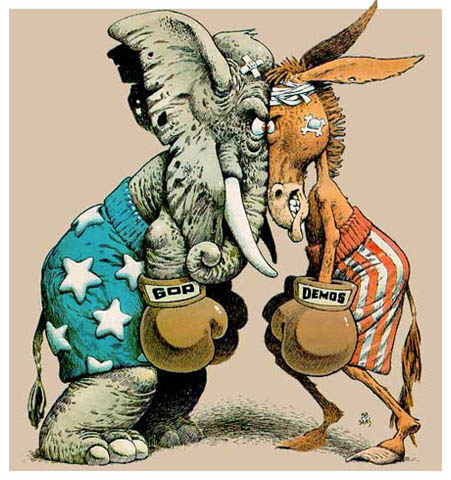
We enter into the world of political affiliations. What are you? A Conservative? A Liberal? Labour? Republican? Democrat? Whether its loyalty to a specific political party (or a cult of personality), or a specific political philosophy, we are generally expected to belong to one.

Through my experiences, most people do not clearly, cleanly, or easily belong under one philosophical political umbrella, but bits and pieces of many. It becomes another artificial piece of our identity.

Not serious or mature or grown-up enough? There's still more. Religious affiliations.
Religious affiliation is all about tribal (corporate) identity. ...Yes, most will venomously deny this. They'll claim their religion is about compassion and love, not tribal identity. But Compassion is an evolutionary step away from Tribalism.
True Compassion and Tribal identity are incompatible.
Compassion necessitates charity of some sort as well as selflessness.
Once we begin down that path of giving up a sense (and definition) of Self, so too do we move away from our delusional sense of Ego and begin distancing ourselves from identity.

The compassion that many religions offer is really just pity. Possibly the real compassion is reserved for the exclusivity of its members, like an insurance policy. But conditional compassion - compassion bound by tribal borders - is not compassion.

Our entertainment, our sports, our political views, and religion, and even our work. All these sources of identity that we seek out and cling to only ever reinforce and build the Ego. Our identities are founded on our Fear, Envy, and Delusion.

Envy is Compassion's opposite, for not only does Envy look out for 'number one' (ourselves), it also desires others not to have and to be without. Envy thrives on their failures as well on its success.

Our fearful and envy-driven Ego embraces a Zero-Sum belief or worldview. In order for there to be a winner, there must be a loser. In order for me to succeed, someone must fail. Paying the workforce less makes more profit.
Every source that supports the Ego and builds our identities subscribe to this. Labour Unions are perfect examples of an Envy-based Zero-Sum system.

The Zero-Sum worldview of the Ego cannot fully understand the concept of Compassion. If I give something away with no return, I simply have less and the other gains. (Capitalism/Consumerism is founded against this). I think this is where many institutional religions fail. Although they are attempting to practice and promote Compassion, they are still stuck in their Zero-Sum views. The only logical justification for Compassion and Charity in a Zero-Sum system is a reward in the afterlife (Paradise, Heaven, etc.), but ultimately this only creates self-serving (albeit well hidden) spiritual hedonists*. (You're only doing it for the fair exchange you're hoping to come in the afterlife).

True Compassion only properly functions in a Non-Zero-Sum system. In fact, Compassion embraces it.
Non-Zero-Sum believes that you can have win-win scenarios.
"It's not whether you win or lose, but how you play the game". My success is dependent upon the team's success. Pay and treat the workforce properly and appropriately and the business will profit.
Universal Health Care is a perfect example. Yes, through taxes, the wealthier will pay to support the less wealthy worker, but a stable and healthy workforce benefits the entire system. There are no losers in this system. This is Non-Zero-Sum.

I think religions functioning within a Zero-Sum worldview had limited potential but was the best we could hope for in its day and age. But I wonder if we are on a spiritual cusp; at the verge of entering a Non-Zero-Sum worldview.

What happens, spiritually, when we decide to abandon our religious identities?
What does this look like? What does that make us become? Could this be this elusive Kingdom of God that Yeshua speaks of? Could this be the clean and clear mind of Enlightenment the Buddha teaches we are already in possession of?
Why are we so driven to find and establish our alleged identities?
Could this very act be what blinds us all?


*(On a side note, I think this is where Paul and Yeshua may differ. I believe the Kingdom of God that Yeshua refers to ("One day the Pharisees asked Jesus, "When will the Kingdom of God come?" Jesus replied, "The Kingdom of God can't be detected by visible signs. You won't be able to say, "Here it is!" or "It's over there!" For the Kingdom of God is within you". Luke 17:20-21, NLT) is a corporate entity that embraces Non-Zero-Sum thinking, while Paul - for all his good intentions - was stuck attempting to understand this Kingdom of God through his Zero-Sum perspective ("I press on to reach the end of the race and receive the heavenly prize for which God, through Christ Jesus, is calling us." Phil. 3:14, NLT).

Monday, July 8, 2013

"God's Favorite Place on Earth" by Frank Viola: Commentary and Review

Allow me to apologize in advance. This short book review is more about me than the book itself. I have often wondered, as a non-Christian (or maybe an ex-Christian... or maybe I never really was a Christian... Good God! maybe the Calvinists were right!), why do I write book reviews of Christian books? And why do book authors and Christian book publishers want my opinions, and why are people (or Christians) interested in my non-Christian thoughts?

Well, ultimately, I think I know why. I may be a non-Christian but I have not totally abandoned everything Christianity has of value. I would rather not define myself as a non-Christian or an ex-Christian, but as simply having moved beyond Christianity (and that necessitates keeping or absorbing at least some aspects and values of it). And that gives me a somewhat clearer vision of what I see, hear, and read.

Christian books in the past that have received bad or poor reviews from me generally have certain unfavourable elements. They use bait-and-switch trickery and mislead; they are too preachy and condemning or judgmental; sometimes they simply can't connect to the common man.

This book however - "God's Favorite Place on Earth" - is none of these things. The author starts out by comparing the tiny town of Bethany to the colossus Jerusalem. I believe the messages and lessons Frank Viola is attempting to communicate are good, simple Christian ones (mind you, for the internal Church-going Christian; not those on the fringe)... but he never seems to get any traction. He failed to ever grab my attention or interest. Although not a long book, I read through it like it was a task, an obligation. (It was as joyous as reading through the book of Leviticus).

I wish I could say or comment more, but unfortunately I have little more to add. It simply wasn't an engaging book.


Disclosure of Material Connection: I received this book free from the author and/or publisher through the Speakeasy blogging book review network  I was not required to write a positive review. The opinions I have expressed are my own. I am disclosing this in accordance with the Federal Trade Commission's 16 CFR, Part 255.


Saturday, June 29, 2013

Entrapment

I believe it was the Buddha that had once said we are all enlightened beings; we just don't know it yet.

Our natural state is enlightened. I'll borrow from the Taoists when I say I believe our innate state is our Wu Wei Nature, it's just blocked.

I call this state, or at least the avenue towards it, The Dharma Entanglement.
Solace and Compassion are entangled by Dharma”.

It's important to understand what these terms are and aren't.

Solace is basically inner peace. Solace calms one's fear of suffering. Fear is its opposite and fear fetters solace.

Compassion is a form of empathy, but much more than that. Compassion is action. It will not just sympathize, it'll do something about it. To only sympathize is Pity. And Pity is a very pale reflection of Compassion.

What will block and impede Compassion is Envy. Yes, there is fear and jealousy, but Envy is much more damaging and dangerous. With Envy there is also the intent or desire (either directly or indirectly) to inflict misfortune or harm onto another. Not only do you desire what they have, you don't want them to have what you possess. It is Compassion's opposite and a stumbling block.

Although Dharma is a Buddhist term, I don't see the concept as exclusively Buddhist. I believe the Buddhist's understand it and draw from it, but don't 'own' it.

Dharma is our openness and willingness to accept the truth, whatever it may be. Our receptiveness to it and our ability to allow it to lead us, rather than force it to fit our preconcieved notions and agendas.

The truth never needs defending. Only our truths needs defending.

If we are open and aware and allow ourselves to be led where ever it is that the truth leads us, we consistently reduce the levels of delusion in our lives.

Delusion is Dharma's enemy.

Solace and Compassion are entangled by Dharma.
These three form The Dharma Entanglement, and this leads us back to our innate Wu Wei Natures.

Fear, Envy, and Delusion lead us astray. They form our illusionary Ego and our Ego entraps us, imprisons us, and stagnates our spiritual growth.

When we associate ourselves with some sort of tribal identity we add to this toxic concoction a Corporate Ego as well.

This tribalism of Corporate Entities can be anything from a favourite sport's team, to a political party or position, to a nationalist (being patriotic), to religious affiliation, and the list goes on.

Saturday, June 15, 2013

The Mu Portal

The Dharma Entanglement is blocked by the encircling Ego.
We are entrapped by our Ego.

Ego is fabricated by three elements; Delusion, Envy, and Fear.
Dharma, Solace, and Compassion compose The Dharma Entanglement and our innate Wu Wei Nature, for Dharma emancipates us from Delusion, Compassion from Envy, and Solace from Fear.

The way forward through these blockades and barriers of the Corporate and Private Ego is through the Mu Portals.

~ ~ ~ ~ ~ ~ ~ ~ ~

The heretical Rabbi, Yeshua of Nazareth, spoke of a strange and elusive concept he called The Kingdom of God. Something that was yet to come, yet strangely present in the Here and Now; within ourselves (Luke 17:21). An unrealized potential.

Yeshua was an exemplar; he was a Revealer rather than a Redeemer. It is religion, religiosity itself that kept us ignorant, captive, and slaves.

What I believe Yeshua truly taught wasn't the advent of new religion (Christianity), but a heightened awareness - a sort of freedom and enlightenment, rather than a salvation. Yeshua's Kingdom of God wasn't a new religion, but the end of all religion. The escape hatch from this Edenic Birdcage; emancipation from the Entrapment of Religiosity itself.


~ ~ ~ ~ ~ ~ ~ ~ ~

Mu is Japanese for “not” often used as a prefix, but can stand alone, simply as 'not'. It can mean to “unask the question", suggesting that the problem does not lie within the answer (there is no correct answer), but within the question itself. The problem needs to be approached from another point of view. I think this gateway is critical to one's spiritual journey. Without it, it is simply stagnation. Growth becomes impossible. The entrapment of religiosity remains unbroken.

Although there could be many possible paths to the Dharma Entanglement, ultimately I believe “Mu” is a necessary gateway to escape the shackles of Religiosity and enjoy the emancipation of Spirituality. (Only then can Spiritual Solace be realized, cultivated, and nurtured).

I think this may very well be the defining difference between the Religious and the Spiritual; parting ways from the disease or plague of religiosity. Abandoning these slave masters.

I have found many monotheists, as well as many Atheists, lack a healthy sense of Doubt, and suffer from an addiction to Certainty. And when we fall victim to the Certainty Addiction everything becomes a matter of knowing and fact and proving one's beliefs. Faith dies. Truth takes a back seat to being Right. Thus enters the hidden and silent inner conflict. Combine this addiction with inner conflict and the monotheist's concept (fear) of Damnation and their Solace's destruction is complete.

What we need to discover is our Mu Portal. Not only an exit point from our own dependencies on religiosity, but the knowledge and wisdom to realize that our religiosity is not only unneeded, but the one thing that kept us captive. It is the only way to attain Spiritual Solace and growth. It is our only way to break Fear's grip.

Mu” (regardless of which avenue one arrives here or even by which name one recognizes it as) is the ability of simply 'letting go' and be at peace with not-knowing. What is important is the meanings and the lessons and the wisdom that are behind these myths, images, and symbols. These stories can be just as true for the Atheist as they are for a Christian or Buddhist or a Muslim or a fill-in-the-blankAllowing a Faithful Doubt (rather than a Doubtful Faith) and living at peace with its mystery. Something many religious people (especially institutional religions) struggle with.

The Mu Portal doesn't belong to a specific religion or spirituality or tradition. All traditions have their Mu Portal(s) and they're not limited to one each. There could be as many Mu Portals as there are people. They may look drastically different and their purpose is not necessarily to deliver away from their individual religion, faith or tradition.
(But most often, I should imagine, it would drastically open one's eyes; rather seeing it as an exit from their religion or faith or tradition, they may prefer to see it as moving beyond it).

The Mu Portal frees the individual from the confines and entrapment of religiosity.
I believe a great many people never find the Mu Portal and never seek it.

I believe some, discover or stumble across it. Their first experience with it would be extremely confusing and terrifying – causing them to flee into the perceived comfort of the familiar and structured and established. Many will never revisit it again.

But some, even as frightened confused and wary of its extreme alien-ness, will sense a truth and an attraction to it and be slowly drawn back.

It won't make sense. It can't. By its very nature it is incomprehensible from the context it is being viewed from.

It is a spiral stairway with no banister or railings on a space station.
Without the railings there's no support structure, no guiding rules or regulations. Without the banister there's no safety; no protection from falling.
It isn't until you realize in 0-g you can't fall but only float.

It's difficult and challenging to understand this because of the context you were always taught to view things from. That is the nature of the Mu Portal.

It is both an Inner and Outer Journey.
To break free of the Edenic Birdcage, the Confines of Religiosity; to pass through the (1st) Mu Portal is to escape from the Corporate Ego. (This is the Outer Mu Portal).

The second Mu Portal (inner)delivers one through their Personal Ego and into The Dharma Entanglement and to their true and innate Wu Wei Nature.

But it is vitally important to remember, what I speak of belongs to any and all traditions. I use some Taoist, Buddhist, and Christian terms (and even some I've been forced to name an label myself), but I am only capable of seeing this from my own experiences and attempting to express it from my own point of view.

Our innate Wu Wei Nature - this Dharma Entanglement - will be known by many other names and experienced in many different ways. Our Corporate and Private Egos will be known as something different as will out pathways and 'escape hatches'. Our passing through the Mu Portal will look like hundreds of different stories.

The last thing a corporate entity - an institutional religion - will allow is the escape of dependency upon itself. Of course most traditions don't speak of it, nor name it, or acknowledge it. It is the reason Yeshua was killed. It proposes the end of all religion. It is not important what we call it. What's important is that you acknowledge the Mu Portal's existence. 


Thursday, June 6, 2013

Te: Spiritual Sojourner

The road to Spiritual Solace can be a tricky and hazardous one. The traveler may themselves seek protection from the trials and tribulations of life itself; the futile hope to become insulated from uncontrollable changes. Then there's also the pitfall of those organized religions which are all too happy to offer these empty promises, often with conditions of becoming 'good', or 'good enough' – by defining what 'good' is and must be.

It's a bait and switch tactic. Spiritual Solace on the condition of being 'good' will bring you fulfillment and happiness, but, ultimately, what you get is entrapment.
“...chasing an illusion of what it means to be a ‘good’ person: by being too humble, self-sacrificing or introverted; by thinking simplicity means denying themselves practical, emotional and spiritual support and abundance; by trusting everyone and everything without reservation or question. Rather than living within their ‘Te’they restrict their integrity and potential by following someone else’s guidance, expectations or demands, of what is ‘appropriate’,‘virtuous’, ‘moral’ or ‘good’. They work hard to be‘correct’ and yet they feel unhappy, unbalanced and unwell, and they don’t understand where they are going wrong.” 
I know I've encountered these obstacles in my over 25 year spiritual journey. My mother's death triggered it. From the hallow ritualism of Catholicism and its unofficial belief that you don't really deserve spiritual solace, to Atheism's lack of any promises (empty or otherwise) and its absolute lack of any path or hope, to Christianity's close minded  spiritually shallow bandage solutions, to Gnosticism's cynical (and hopeless) world. One always ended up falling short of being good enough and solace would only ever be found in ignorance or denial. (And please don't take my comments as insults against these world (or not so worldly) religions. There are only my personal experiences). Freeing oneself from these 'religious' fetters is the step in the right direction. This is the Mu Portal, escape from the Edenic Birdcage.

It was the longest time before I could readily identify what I was really searching for and then sometime before I could admit it. I wanted to find happiness (when I only had to unlock it) and I wanted to be protected from the worry and anxiety of uncontrollable change (when I needed only to embrace this apparent chaos). This was the entrapment.

It was 5 years ago that I stumbled across Jungshin Sooyang (“Moral Culture”) in the beginning of my journey of attaining my Black Belt in Taekwon-do. And Jungshin Sooyang was my first real and practical encounter with Taoist concepts and tenets. (Through Taekwon-do I learned that one of my biggest challenges and obstacles was Fear itself).

I have also experienced startling healings through acupuncture, also based upon Taoist concepts and influences.

I think that is why for the past 5 years I've been slowly gravitating towards Taoism and Buddhism.... and that should be a bit surprising, because for what I claim to be looking for, it is the last thing Taoism offers.

David James Lee, of Wu Wei Wisdom , might have stated it best (if somewhat bluntly) when he asks:
Do you seek out the certainty and comfort of life’s smooth and open road, whilst secretly fearing the hidden corners and unknown twists and turns that inevitably lie ahead?
All life and energy will move and transform whether you like it or not...the hidden corners and unknown twists and turns will always remain.”
My answer to his question would have been “yes”. However, I've also realized that isn't my
answer but my Ego's answer, and my Ego, I am not. (That I learned from Buddhism).

In Taoism the only thing that never changes is Change itself.
What an unsettling thought!

And that is where my warfare with the Ego commences. That is where my wu wei nature comes into direct conflict with my illusionary self (Ego).
Understand that your Ego may try to control the direction and speed of your life journey as a misguided form of self-protection. Unlike your... Spirit centred mind, your restricted Ego... doesn't perceive value in the unknown or the unfamiliar. Instead it constructs negative outcomes and certainties where none exist. 
Remember, your Ego is your friend yet you should always take firm and loving control of it, almost as if it’s a scared or out of control child. Allowing yourself to be enticed by its illusions of an imagined future will draw your precious energy and attention away from truly living in the present. You begin to assume that change and uncertainly always mean disaster and distrust your authentic ability to be flexible, creative and resourceful in the face of new or unexpected circumstances. 
Moving away... like this disconnects you from the abundant and glorious flow of Universal energy. You separate yourself from Oneness. Most importantly, you overlook the many possible lessons.” Wu Wei is trusting as you move into the unknown 
I think that's where my attraction to Buddhism comes into play. Buddhism has the facilities to educate and give you the tools to engage this illusionary adversary.

Having long since moved beyond Christianity, I find myself at the crossroads where Taoism and Buddhism meet... and I think I very much like this place...

Am I there yet? No. To be honest, I'm not convinced there is a 'there' anymore. But for the first time in over 25 years I'm on the path.

haven't found a spiritual destination I call home (I'm coming to the conclusion that there isn't one), but I've become at home with this spiritual sojourner I have become. I'm beginning to think I am, at long last, following my Te.

Wednesday, June 5, 2013

God's Favorite Place on Earth


Shortly, I will be receiving a review copy of God's Favorite Place on Earth by Frank Viola. The book released May 1st and stayed in the top # 50 on Amazon.com for 8 straight days. There's a lot of buzz about this book on the Web, and I plan to write a review after I read it. 
Here are a few interesting nuggets about the book:


  • It's been recommended by 47 Christian authors, including John Ortberg, Jack Hayford, Leonard Sweet, Tricia Goyer, Mary DeMuth, Greg Boyd, Todd Hunter, Jon Acuff, Phil Cooke, and many others.
  • Here's a book trailer introducing it: http://www.youtube.com/watch?v=RG_9TeE-BO8
  • The book tells the story of Jesus in the little village of Bethany and the amazing things that happened there through the eyes of Lazarus. It combines biblical narrative, dramatization, theological insights, and nonfiction devotional teaching. It argues that "Bethany" was God's favorite place on earth and explains how every Christian and every heart, home, village and church can be "Bethanys" today for God.  
  • The book addresses 18 specific struggles that Christians face today and offers hope, challenge, and fresh insight. 
  • You can check all of this out at http://GodsFavoritePlace.com and get the book on discount.

    Tuesday, May 28, 2013

    Why Don't Men and Women Share Public Washrooms? A Synchroblog

    I always enjoy what random and unexpected places a discussion or idea can lead you to. It's a meandering path! You start out here and eventually, end up somewhere surprising!

    We're going to try something new – a Synchroblog. One topic, three blog sites and 3 independent bloggers. All with our own take (Although I feel somewhat out of my league with the writing and blogging talents of these two captivating women.) Jewels from According To Jewels, Lydia from On The Other Hand, and of course, myself of The Woven.  Let's see where we end up!

    ~~  ~~  ~~

    Why Don't Men and Women Share Public Washrooms?

    This topic isn't new to the blogsphere. I began by surfing around the internet trying to get a general feel of what people thought. The majority of responses fell within 3 groupings: 1) Safety, 2) Privacy, and 3) Culture (as in, it just is culture. It's what we know. It's what we've been taught and conditioned to). And there is an abundance of humour to be found here. I also discovered that, apparently, in Japan men and women share the same public latrine. Which got me thinking whether the first 2 concerns (Safety and Privacy) were really just projections that might fall under Culture.

    And there was also a 4th group, but far from a majority. Some believe we have men and women public W.C.'s because of gender-policing. That caught my attention, because for our freedom-based Western values, it sounded a little bit too Orwellian; Totalitarian; 1984-ish (the novel, not the year. I love the '80's).

    Is there really a danger of sexual assault or harassment – even being given 'the look', the once-over, being uninvitedly checked-out, if we were to introduce unisex public washrooms?

    If we can find examples where mixed public bathrooms are the commonplace and without an increase of cases of sexual assault or harassment (which we have in Japan) then this reasoning becomes more of a cultural projection of fear. (Unless the Japanese are more in control of their 'animal longings' than we are).

    Fact is, we are commonly seeing more Family Friendly washrooms and even change rooms. Do we really believe we are all driven by lust and violence?


    In our more modern times, there is a significant higher level or awareness and tolerance of gay and lesbian members of society. If gender-based washrooms are based upon safety (from the threat of sexual assault), then with the advent of this relatively new (in historic terms) element we should see this manifest, which I don't believe we do. That could stem over into privacy issues as well. Would I be comfortable using a urinal beside a man I know to be gay? I am not homophobic, but no, I wouldn't.

    Privacy? Well, here's my thoughts on privacy. Stalls are private. Some washrooms are single-occupant rooms with proper doors and deadbolt locks. But most importantly, the entire concept of Privacy in a public environment is somewhat of an oxymoron, isn't it?

    One blogger posted their concern for poor little Sally walking into a unisex bathroom and seeing Uncle Joe's junk at the urinal. As far as urinals go, I should think the urinal evolved alongside the gender-segregated system. (I know many men who do not like urinals for lack-of-privacy issues).

    The fourth option, that I suspected but rarely heard mention, was gender-policing (... I'm afraid this is where it gets heavy...)

    ~~  ~~  ~~

    We Westerners seem to demonstrate a strong habit for gender policing to enforce the binary of “man” and “women”; boys and girls. There's several issues worth establishing here. Although biologically, gender is simple, we know that culturally and sociologically, gender is quite complex. The simple point of view of, Take off your pants; you're either a guy or a girl, is a little bit too shallow. If that were the case, then we would wear clothing purely for practical purposes. We would not have gender-specific articles of clothing nor would we have gender-specific styles (Woman's ski-jacket vs. Men's ski-jacket). This issue greatly transcends public washrooms. Gender is much more than biological or sexual orientation. (Actually, I might argue that Sex and Gender are two different things altogether).

    I can't help but wonder if our Western perspectives have it all wrong. If we look at the hijras of India, Bangladesh and Pakistan, the Fa'afatine of Polynesia, the Two-Spirited people of Native Americans and Canadian First Nation's people, we see old and ancient people who have long since recognized this aspect within humanity. This is not a new or modern idea of tolerance.

    In our Western culture, homosexuality was officially considered a mental illness (insanity) until 1972! Let alone any idea of an “other” or 3rd gender.

    "So why don't we have them within our culture or communities then?" some may ask; the assumption being, if we don't have them, then they cannot be a regular part of humanity – that they are a product of a tolerant culture that allows them.

    I would put this logic in the same category as President Mahmoud Ahmadinejad (pronounced nut-job) stating to the UN Council that Iran does not have homosexuals. It's laughable. Of course Iran doesn't have homosexuals! They're shot! They're there. They're just quiet and hidden. Maybe even lost.

    It is difficult if not impossible to deny their existence within the human condition and experience. Maybe they are an exception, a sort of one-off mutation? A perversion or deviant (from a biological/psychological point of view) of some sort; that they are not a regular or healthy minority but an aberration?

    In 2005, Indian Passport forms were updated with three gender options. The Hijra of India are probably the most well known third sex type in the modern world. The Humsafar Trust – a Mumbai-based community Health Organization – estimates that there are between 5 and 6 million hijras in India. That's a pretty big number (Even as a percentage that's still around 0.5%. That's the same as the Black Hispanic population within the USA).

    My point simply is, maybe they are a natural aspect of humanity. One in which our Western world-view has attempted to stifle, repress, or snuff-out. Maybe to the determent of our entire society. Is our society guilty of behaviour manipulation?

    Western medicine with its symptom-treatment “take-a-pill” philosophy. Fast food, Instant information, instant gratification. Materialism and consumerism run amok. Online social networks at the absolute decay of real relationships. Gender-policing.
    The more and more I learn and see of other, non-Western world-views, the more and more I am coming to believe we got it wrong. We got it so wrong.

    ~~  ~~  ~~

    Okay, okay.
    A bit too heavy.
    Let's bring this back down to a more mundane reality. 
    A few of these facts I knew of. Many were eye opening. 
    The world as I know it is not the reality of what the world is.

    My world's not real. I think it's healthy to keep that in mind.

    ~~  ~~  ~~

    Okay, okay. Even lighter still.
    In my journey through the googleverse in search for ideas and pic's for this post, I couldn't believe the urinals that are out there! From the fun to the profane, they'll make you laugh and they'll offend you. (I thought to myself, Holy Crap! Do I live in a bubble?). Here are some that - one way or another - caught my attention.


    ~~  ~~  ~~

    Now, if you'll excuse me, I have to go to the little boy's room. ;)


    Monday, May 20, 2013

    Qi: Evolution & Entropy

    I believe we are entering a new and uncharted world. A spiritual world some might argue; a world in which answers are needed. And for the first time in modernity, a world in which science cannot provide all the answers.

    Recently there seems to be a 'theme' occurring with the books that are falling in my lap; that I am reading and reviewing.

    The Enoch Factor, by Brian McSwain, Evolution's Purpose by Steve McIntosh or, A New Earth, by Eckhart Tolle to name a few. In one way or another they all share the similar theme of an evolving universe or our relationship to it. This has led me to revisit and reread Yatri's Unknown Man: The Mysterious Birth of a New Species.

    In 1988 I read Unknown Man. Much of it I didn't absorb or retain. What little I can remember was that Man was going to evolve and a new human species (homo novus?) was among us. Twenty-five years later I am reading it again. I think I simply wasn't well enough read or versed to take most of it in at the time. I think this marked the solidified beginning of my spiritual sojourney.

    What these books (including Unknown Man) all have in common is the idea of the universe evolving in a direction. From the Big Bang to cosmic evolution, to elemental evolution, to a geosphere, to a biosphere, to a social-cultural evolution, and - potentially - to the Noosphere.

    Although it is something I believe, I needed to find some way of rationalizing it (from my own knowledge, experiences, and encounters) without resorting to a supernatural answer - without some sort of belief in 'magic'.

    I found my answers in Taoism and my personal encounters with acupuncture and my Qi.


    The ancient sages of China noticed the whole of creation was reflected in each of its parts. An atom is a miniature solar system. A human body is a miniature universe. The inner world they called the micro-cosmos, the outer world they called the macro-cosmos.

    A basic belief of Taoism (and much of Chinese acupuncture) is that the human being is a microcosm of the universe. The living 'life-force' - this Qi - permeates all things living, and flows and ebbs.

    What is Qi?
    "Qi is the energy that underlies everything in the universe. If it is condensed it becomes matter or if refined it becomes spirit... 
     "Qi is variously called ki in Japan, prana in India and rlun in Tibet. It has been translated in various other ways including 'influences', 'life force', 'breath' or 'vital energy'.    
    "If you tried to see particles of Qi through a microscope you would not find it, but the restoration of its balance is vital to restore a patient's health. Everything that is living, moving and vibrating does so because this invisible substance moves through it."Angela Hicks, "The Acupuncture Handbook" Piatkus, 2005, pg. 101-102.
    Entropy: Everything in the universe seems to move towards this direction. From order to disorder. Things eventually break, wear out, or breakdown. We don't see things fix themselves.

    However, Life seems to work against entropy, or at least challenges it. Living things evolve. Living creatures - living systems  - become increasingly more complex and more organized.
      
    Evolution and Entropy are quite literally the universe's Yin and Yang.


    The symbol of Yin and Yang is a beautifully harmonious representation of this flow and ebb and abundance of Qi in the universe, reaching its fullest potential, then transforming into its opposite - like a bellows opening, creating space and filling with air, then closing and collapsing, expelling the air - continually flowing, flexible, and moving.

    What is true within a living being is also true within the universe. If this is true on a macro-scale (cosmos) and also reflectively true on a micro-scale (living beings), then there is no reason to believe it cannot be true on a intermediate, or meso-scale.

    Qi is simply various forms of energy that flows and ebbs between the two; what allows them to 'move' and 'become'. (Maybe Qi is negative entropy; negentropic energy?)

    Qi energy can flow and pass - or a least influence - one another. When or if this occurs and becomes active or 'activated', it will accelerate and amplify.
    I believe this action is, or can become, this Noosphere.
    This is the next evolutionary step of mankind. (Or from a Taoist point of view, possibly a devolution to return to the Great Integrity - the Tao). 

    When James Lovelock as asked by NASA in 1964 to figure out a way of detecting life on Mars, he questioned exactly what was life and how would he look for it? His answer?
    "I'd look for an entropy reduction, since this must be a general characteristic of life"
    The Noosphere is like a bubble, kind of like a force-field protecting those within from the surrounding entropy; a safe-zone where the local entropy has been reduced to zero, or even a deficit. 
    I know there are a great amount of opinions as to what exactly this Noosphere is or might be. From Vernadsky's to Teilhard's definitions, to the Gaia Hypothesis to a world like that in James Cameron's movie Avatar, even to a planet wide Mind with its synapses being the inter connectivity of the internet. 

    Many cultures would seem to be aware of it by various names. The Abrahamic Faiths hold onto utopian dreams of Heaven and the past Garden of Eden. Hinduism and Buddhism hold onto Moksha and Nirvana (both being utopian states of mind rather than places), and Taoism has Lao Tzu's perfect moral culture. Even Humanism has the idea that "human beings... can build an enduring citadel of peace and beauty upon this earth" (The World Great Religions, Time Incorporated, New York, 1957).

    I'm not sure it's overly important what it might be
    It's not here yet; it's coming. It will be what it will be. It can't (or shouldn't) be forced. 


    Friday, May 17, 2013

    The Quarantined Church

    Ignorance and arrogance go hand-in-hand so I think there should be a degree of awe and wonder – like a child's – as well as humility and open-mindedness. The only way around ignorance is education, not indoctrination, and the only way to become successfully educated is the abandonment of arrogance.

    Although many Christians have honed their Humility down to an art form, when it comes to issues of Belief that humility and open-mindedness are replaced with a knowledge-filled arrogance. These rigidly-denominational Christians are the modern day Gnostics. Those that unswervingly and unquestionably follow their denomination's teaching and swear that it is truth and righteous.

    And although I've just labeled it “rigidly-denominational Christians” it manifests itself in other less obvious ways. My favourite are the self-titled “Bible Christians” who claim not to follow denominations or traditions but only the bible... please. They are no different; just a little bit more creative and a little bit more dishonest.


    At the end of the day, the only thing all these have in common is that they believe in the bible. Where they all differ in what it says or means. With so many interpretations and numerous proper hermeneutics and various doctrines and heretical views accepted and denied, it should become obvious that the simple truth, the answer, is anything but obvious.

    In time it becomes a private issue of tribalism and being right over pursuing the truth. Then we enter the realm of ulterior agendas and the Evaginated Christian emerges. (No, I didn't misspell “Evangelical”). Something else is being sold, either instead of, alongside of, or on condition of, the truth. They have done worse than turn it inside-out. They have evaginated it; they have turned it outside-in. There are those on the outside and there are those clearly on the inside.

    Historically, we have seen this on a near 500-year cycle. There was the establishment of the Roman Catholic Church (and the purging of the Christian Gnostics) by Emperor Constantine c. 5th century. There was the Schism of the Eastern Orthodox Church c. 10th century. Then there was the Protestant Reformation c. 15th century (and what followed to be The Splintering are numerous denominations. Maybe this Splintering is more of a byproduct of Americanism. “The Church of the Individual”. Maybe these numeral denominations should be collectively referred to as “American Christianity”). Now there's the appearance of the Emergent Church c. 20th century.

    I would imagine the real 'church' (community) to be varied and should include non-believers. A place where questions and struggle and doubt are not discouraged or treated with The Stick & The Carrot.
    I think Christianity could learn a lesson from Taoism's idea of four types of societies. The lofty idea that a perfect society's people are not motivated by reward or fear of punishment.

    The Stick & Carrot vs. Grace & Mercy. These concepts are polar opposites yet both seems predominant within modern Christianity as they preach Grace & Mercy but they practice The Stick & Carrot). Maybe that is what is wrong with Christianity today? The existence of the Stick & the Carrot methodology is a trademark of Religiosity. However, truly unconditional Grace will do away with Religiosity and Religions for that matter. They will be the hallmark of the End of Religion. Christianity comes so close to this, but at the end, at the very last minute, cling to their individual Ego-driven collective identity as a “Christian” and undo the entire process.
    You know what? Maybe the church of “True Believers” sitting in their pews, singing their hymns, safely tucked between their church's walls, bound by their unspoken rules and regulations of what you should and shouldn't do and can and cannot be, is a great idea! Maybe they should be quarantined off. I can't think of a better way of stopping the spread of this marketed corporate mentality.

    We should strive to be a perpetual student. Always learning, our focus on continual growth, not continual stagnation.

    The real questions we much each individually ask ourselves are, Am I only following what I've been taught but never questioned it? Am I following my priest, my minister, my pastor, my Rabbi, or my Imam? If I were born in a different culture would I still believe what I claim to hold a true? Have I looked outside of my quarantined world? Am I loyal to my belief-mechanism or to the truth and wisdom and source behind it?

    Am I spiritually in motion in my faith, or am I static in my belief?
    Am I a member of The Quarantined Church?

    If not, then what are you? Are you a fringe-dweller, existing on the outer frayed edge? Are you a mouse living between the walls of the rooms we call Denominations? Or are you living in a spiritual wilderness? Are you a Wanderer, and if so, are you lost or on a quest?