Showing posts with label Buddhism. Show all posts

Sunday, October 12, 2014

Returning to the Torn Veil

What does returning to the Torn Veil look like?

Modern day Western religions all have 2 sacred cows in common.
Membership (or proselyting) and tithing. (It's ironic that Jesus – through the Torn Veil – attempted to break or do away with these things).

We face a few difficult challenges and obstacles here.
Firstly we (collectively) must admit that part of the human condition includes Spirituality. No, not necessarily Religion. (There's a difference). Atheism is a knee-jerk reaction (and rightfully so) to Religiosity, but never-the-less just as unhealthy as Religiosity.
Atheists too have their Spiritual aspects or facets, although many are unwilling to admit it, or will choose not to label it “Spiritual”.
This is the first challenge and obstacle. Collectively admitting that Spirituality is a Human Condition.

This 'knee-jerk reaction' is to what we understand religion to be; namely, Western Modern day religion with their 2 (primary) Sacred Cows.
What are its obsession with Membership and Tithing all about?
Well, look at it like this: You want people to either desire or need what you're selling in order to create a revenue-stream.


That's a business model. That's a good Business Model.
But it's a lousy Spiritual one.


Interestingly, if we look at some large Eastern religions, we see something very different. I'll could Buddhism and Taoism. (I won't use Hinduism because, although its population or numbers are very high, it's extremely concentrated in specific geographic locals).

Now, to be fair - especially for those naysayers and those who simply love to be right and refute others - if you want to throw stones at Buddhism and Taoism there is plenty of ammo. Both are very old religions. Taoism has really two facets. What I'll call Folk Taoism and Modern Taoism. Fold Taoism is where you'll see the stories of gods and Divine people and the like. Mythology to be sure. Same goes with Buddhism. What further complicates matters is that Taoism (for example) is not structured like Western Religions and often doesn't make sharp distinctions between these two aspects. My point being, if you want to throw stones, there's plenty to throw.

But, a few points worth noting are that these two religions do not focus on proselyting, evangelizing, or membership. They are not built upon the Business Model. There's build upon a Spiritual one. (I believe that in our Western worldview and values, we have left Capitalism run amok).


In fact, the Dalai Lama says to “Stay in your own religion and mediate”, not to convert to Buddhism. Not only is this not proselyting, it is its very opposite.


Taoism promotes simply finding truth. 
Because things in the world change, there is no reason to hold tightly on to any reaching or establishment that began tow or three thousand years ago. Only the helpful principles that were taught should be followed, because principles do not change. All good principles can merge together as one good unified principle that exists prior to any of the momentary teachings that were developed." Master Hua-Ching Ni

These are not about building Empire, the growth of membership, or the amassment of wealth.

Two other (lesson) sacred cows Modern Western Religion hold onto are Doctrine and Self-identity.
The 'big' Western Religions (among others) focus on self-identity. If you are a Christian, then you are a Christian. You must self-identity as such. As with Muslim, as with Jews.

Not so with the Eastern.
Both Confucianism and Taoism complement each other, however incompatible they seem at first to be. The former places a man in his proper relation to his fellow men, the latter in proper relation to nature. A third philosophy, Buddhism, though introduced from India, deals with the problem of human suffering and with man's ultimate destiny. These three inheritances... have moulded the thinking not only of the Chinese people but of all Eastern Asian. There is truth, then, in the common saying that every Chinese wears a Confucian cap, a Taoist robe, and Buddhist sandals.Arthur W. Hummel, Former Head, Division of Orientalia Library of Congress, Washington, D.C., 1962, Forward to the Tao Teh Ching.


There isn't this obsession with self-identity as there is in the West.
(Ask yourself, could a Westerner readily claim to hold Christian, Muslim, Jewish values; a sort of Freelance Monotheist? Well, few do, but they aren't openly accepted. They're always accused of sitting on the fence).


The secondary minor Sacred Cow Modern Western Religion holds onto is that of Doctrine.
Although Doctrine is often held to be the glue that maintains truth, order, tradition, and structure, it sadly is not the case. It also includes inflexibility, stagnate growth, control, and simply being right; defending one's position at the expense of the truth.
Doctrine” begins in a position of having a truth and then defending it, rather than legitimately discovering and exploring the truth.
One starts at the end hypothesis and moves to defend it, while the other begins without the hypothesis and move to discover and explore it.

There's a drastic difference between these two actions. 
The "Doctrine-paradigm" sees truth backwards. It doesn't really allow for its exploration. 

The Buddha provided examples and a framework to test his teachings. Nothing was expected to be taken at face-value or carte-blanche. 

Taoism holds onto what I call Zero-Doctrine. Again, a focus on mental flexibility. 

My point in all this isn't to sell Eastern Religions, but to provide a contrast. A measuring stick to hold up against Modern Western Religions. A mirror of sorts.
What does exploring The Torn Veil really look like? I think we need to begin by looking far to the East.


Monday, August 4, 2014

Clear Mind: Aware of What I've Forgotten

It's morning one.
I'm on a 12-day Mediterranean cruise.
I have found myself a somewhat secluded spot on the uppermost sports deck - 13 stories high - to sit on my seiza bench and mediate.

Everybody's asleep. Apart from the occasional early morning jogger, I am alone.
That's good.
No potential audience.
More importantly; no private concern of an audience.

Normally when meditating it doesn't take long for phosphene to begin.
This time it's different.
Although I'm sitting on the shadowed side of the ship, there's light everywhere!
I can't help but be aware of the sea breeze that ruffles my clothing and caresses and messes my hair. My mind is easily distracted, easily reminded of exactly where I am; reminded to a point where it's difficult to do what I'm doing - namely, meditate.

On retrospect, I question whether I should have been forgetting where I was and 'filtering out' the environment I'm surrounded by (as it is a distraction)... but this is a problem on multiple levels, isn't it?

The moment I'm aware of what I've forgotten, 
is the moment I've remembered.

How could mindfulness function in this scenario? I could only accomplish this in retrospect.
But a more serious challenge is the very question of forgetting. Is an oblivious state of mindlessness really what I'm striving for? No. Shouldn't mindfulness include being acutely aware of the environment you're in?

This is a paradox when this very awareness is a distraction from the practice itself. (When being mindful take away from practicing mindfulness).

Although I couldn't put my finger on it, I became acutely aware of a flaw in my practice and my understanding... but I had time for reflection.

I think the answer may lie in a closer look at the (my) meditation practice of Jung-Joong-Dong.

~     ~     ~

The Jung-Joong-Dong as described in General Choi's Jungshin Sooyang (Part II: Section M: "Develop Peace of Mind) is extremely ambiguous. The point of Jung-Joong-Dong seems somewhat confused or hidden.
Upon initial inspection or study, it would seem that this Master confuses meditation and contemplation, or uses them interchangeably or synonymously - at least that's what I initially thought.

But if you dig a little deeper, I believe he means to use them in some sort of holistic and intrinsic way.

The initial point of Jung-Joong-Dong is to strive for Clear Mind.
Although it may be implied or suggested, the method or practice of how are secondary and could even prove to be a distraction (How isn't really important at all).

To quiet the mind (no small feat!) will allow it to settle, like muddy water settles, to become clear (or even return to its original state). Only when we can quiet the mind can we begin to have Clear Mind.

But Clear Mind is not the goal, only a means to an end.

We are meant to have Clear Mind so that we may practice contemplation, or self-reflection. However, attempting to practice self-reflection without the lens of Clear Mind can only promote and lead to Delusion (and if we follow this path to its final conclusion, also fear, envy, victimhood, jealousy, and hatred).

Jung-Joong-Dong two-fold 'steps' are meant to function holistically; meditation and contemplation are kit-and-kaboodle.

Within meditation we quiet the mind and have Clear Mind. Within contemplation we have self-reflection, self-improvement and eventually Solace. Mindfulness acts as the link and bridge between these two.

The apparent paradox of being mindful during meditation as distracting form Mindfulness itself is an illusion.

In this practice, Mindfulness is a byproduct of Clear Mind. Mindfulness finds its birth within meditation. It is a tool for self-reflection. It is the bridge between meditation and contemplation; it is the exit point of meditation and entrance of contemplation and self-reflection. It finds its birth within meditation and is meant to be carried into Contemplation.

....or at least that's my take on it....

~     ~     ~

I realize it may sound like I'm talking a lot of gobbly-goop (I hope not) and maybe even over-analyzing it, but this isn't a well established form of meditation, and I'm pursuing this more-or-less on my own. To my knowledge there are no teachers of this obscure form of Martial-art meditation.

It is definitely an uphill battle.


Saturday, June 14, 2014

Envy

Today, Envy and Jealousy have become synonymous in the English language, with Jealousy taking on and incorporating Envy's definitions. However, they are different and this Envy needs to be properly understood.

This Envy is two (or three) parted.
Firstly, it is when one can justify why they deserve what another has (including the protectionism of  jealousy), and why they don't have it (victimhood).

Secondly, is it when you can justify why another doesn't deserve what they have, and encompasses becoming a "hater" - not necessarily wanting what another has, but wanting them to suffer; stealing their joy from it.
This coincides with what Bertrand Russell has said, that envy was one of the most potent causes of unhappiness. Not only is the envious person rendered unhappy by his envy, but they also wish to inflict misfortune on others.

I think this is the most dangerous aspect of Envy, both for the target of it and the individual suffering from it. Maybe the term "hater" needs to be clearly defined:
Hater (n):
A person that simply cannot be happy for another person's success. Instead of giving acknowledgement in courtesy, a hater often pursues his/her point by exposing a flaw in the target subject. Hating, the result of being a hater, is not exactly jealousy. The hater doesn't really want to be the person he or she hates, rather the hater wants to knock someone down a notch.
There is another dangerous position somewhere between the entrapment of Envy and the freedom of Compassion; a mock-compassion. A half-assed compassion.
It is a deluded version of compassion; Pity.
It is easy to mistaken Pity for Compassion; and there is nothing wrong with feeling Pity. It is only wrong and dangerous when you delude yourself into believing your Pity is your Compassion.
(I would argue that an individual who is tribal - rather than communal - is, at best, only capable of Pity. I would also argue that most institutional built religions (the entity itself, not necessarily the people in it) are all tribal in nature).

It isn't enough that we properly understand what this Envy is, but that we can identify it within ourselves, and, hopefully, purge it.


Saturday, March 8, 2014

Mindlessness, Mushin, and Mindfulness

Before I attempt to briefly define what I understand these things to be, allow me to preempt myself by saying, volumes of books can be read or written on these topics. People can (and have!) dedicated their entire lives understanding and mastering these – topics? Precepts?.
I'm attempting to define these things in a few short paragraphs. It should be obvious they will be lacking.


Mindlessness:

Most of the time, our minds function by generating a constant swirl of remarks and judgements that create a barrier of words and images that separate us from our own lives. This mental condition is called mindlessness and makes it difficult to be mindful, or attentive, to the experiences of our lives.

Most of the time, most of us exist in mindlessness, a state of semi awareness governed by habit and inattention. Most of our daily lives are essentially governed by routine.
Have you ever driven home from work, for example, only to arrive at home, not remembering the actual drive home?

The great value of these habits is that they free our minds to do other things; we do these things without having to expend precious energy trying to make up our minds. The bad thing is what we ultimately do with our minds during this time. (This could potentially be the point in which mushin should come into 'play') Unfortunately, the freedom such routines afford the mind is not well used. If they find a moment when complete attentiveness to the present is not demanded, our minds tend to gravitate to one of two places: the past or the future. Your thoughts may alternate between past and future, but they will tend to avoid the present as much as possible. If you pay attention to your ordinary thought processes, you will discover that you probably spend very little time living in the present.

Mindfulness:

Mindfulness is moment-by-moment awareness; it is the process of attentively observing your experience as it unfolds. Mindfulness allows us to become keep observers of ourselves and gradually transform the way our minds operate. With sustained practice, mindfulness can make us more attentive to our experience and less captive to the whims that drive our minds.

Mushin:

“No mind” in Japanese.
When you do something, you have to concentrate to do it the first time, and the 2nd time; 3rd time, 4th time, and the 10th time, but eventually you can perform the activity without thought; the same way you would dial a telephone number you've dialed a thousand times. Ultimately, the goal is not to have to concentrate, to be able to perform the task with “no mind”. This is how the mind is cleared and readied for enlightenment. This is Mushin.

~  ~  ~

How does Mushin relate to and interact with Mindfulness?
The example (of Mindlessness given of driving you car home without any memory of doing so could very much sound like mushin). What makes the difference between this act being an act of Mindlessness or a state of mushin?

Are the practices and/or goals of Mushin and Mindfulness compatible?
Are Mushin and Mindfulness opposites; or are Mushin and Mindlessness opposites?
Are they different paths to the same place; is one a path to enlightenment and the other a path to well-being?

Mindlessness would seem to be incidental, maybe even a poor default position, whereas Mushin and Mindfulness are deliberate, or strived for 'states'. (But even having said that, it's possible to find oneself in either Mushin or Mindfulness states). Maybe it's better to describe them as a higher state of mind.

Are Mushin and Mindfulness in conflict with one another. By some definitions what Mindfulness describes as Mindlessness also fits Mushin.


Sunday, February 16, 2014

The Spirit of a Martial Art

What is the purpose behind Martial Arts?

Many people will give various answers suited to their person wants and needs. I'm not talking about that.
Yes, there are benefits and 'perks' associated with taking a Martial Art. Conditioning, cardio, physical and mental health, self-defence, and many more. But these are bonuses, or byproducts, not the actual purpose underlying the Martial Art itself.

My Master* makes a sharp distinction. He will unapologeticly say before a group of mixed students that a MMA fighter is a Technical Brawler (his choice of words), while a Taekwon-do student is a Martial Artist.

Nomenclature.
My profession background is in the Print Media. I have been in the industry for 27 years and I see this distinction of tech. and art play out well.

Digital Print is a science. CTP plate making is a science. Offset Printing is a craft.
The differences? A craft (and thus a craftsman) is a combination of science and art.

I think this is a good distinction to carry over into this conversation regarding the Martial Arts. Art is something that does not lend itself well to being analyzed or studied by a scientific model or mindset. An art is something else. We might even argue spiritual.

Many scholars believe that the martial arts practised in eastern Asian have been influenced by the teachings of the Buddha, with notions of enlightenment and spirituality intricately woven into the very fabric of the martial arts themselves. It would be extremely difficult to say that the Buddha teachings promoted war-like (martial) actions.

Yes, “Martial” means or relates to military or combat, or most specifically, war.
The term, or name Martial Arts” is a Western (English) one; sort of a catch-all category that “we've” created. Since we've created it, we define it by our understanding or misunderstanding of it. Although “Martial Arts” has become associated with the various fighting styles of eastern Asia it was originally used in the early 1550's in relation to combat systems on Europe, often specifically to the “Science and Art” of swordplay. So, ultimately, the term “Martial Arts” is a misnomer.

If we go back in history to various times and locations when and where these various “Martial Arts” find their origins, we will not find the term “Martial Art”. What we most often find is various forms of the term “-do”. It means the way of, in the same context as the Tao means the way.

These Martial Arts are not a learned and acquired skill set as we Westerners understand it, but a way of life. 
Granted, we may very well have bastardized it and dissected it into its various components and forced it into what it might be today. But that is our subjective wants picking and choosing.

I don't believe the purpose is to create fighters. I believe the purpose is to create a better (moral) person.
In fact, I would seriously question a Martial Art whose purpose is to create fighters.
Yes, there is definitely a combat aspect within most (all?) Martial Arts, but I'm not convinced this is the purpose behind it.

Mixed Martial Arts (MMA) has focused near exclusively on the combat aspect of Martial Arts, I fear, at the detriment of Martial Arts' spirit, because, ultimately, when a student is trained in MMA, what is being created is a fighter. The spiritual aspect, the growth and betterment of the individual and the world is forgotten or forsaken. How does a MMA fighter stand for freedom and justice and how do they build a more peaceful world?

Maybe the focus shouldn't be on MMA specifically.
I'd be painting with a broad brush to make this statement. Maybe I should focus on the industry of MMA (The UFC makes for a good example). I should include its fighters, coaches, teachers, promoters, and especially its fans, collectively.
I'm not convinced it's a sporting event. Granted there are numerous opinions as to what constitutes a sport. Competition, a sense of sportsmanship, a learned and trained skill set, as well as a degree of athleticism are how I would define a Sport. (ie, darts, chess, and golf are not sports).

Martial Arts would definitely fall within this definition of “Sport”. But, contrary to popular opinion, I'm not sure MMA (or the UFC) does. Where is the sportsmanship of continuing to strike an opponent once they are down, fallen, or even unconscious?
A great example is Ronda Rousey dislocating Miesha Tate's elbow (warning: graphic video). The question should be asked, was Miesha Tate at fault for not tapping out? Was Ronda Rousey at fault for going through with the arm bar to its conclusion? Was her training at fault for teaching her to continue this in the name of “sportsmanship”?
Or was the industry (fans included) at fault to creating this gladiator type entertainment?

We need to take a far step back and ask the question: What is the purpose and spirit behind Martial Arts?

Choi Hong Hi (founder of Traditional Taekwon-do) states in his JungshinSooyang,“This moral culture is uniquely tied in with Taekwon-Do, not only for the eventual attainment of the highest goals in Taekwon-Do and the promotion of power, technique, and self-confidence, but also for the cultivation of character.”, and as reflected in the oaths of Taekwon-do, especially the final two,
“I shall stand for freedom and justice”, and “I shall build a more peaceful world”.

It forces me to ask the question, what is the Spirit of a Martial Art, and have we lost our way?


* 7th Dan Black Belt in Traditional Taekwon-do, Certified Muay Thai Professional Trainer-Kru, Brown Belt in Brazilian Jujitsu, MMA Instructor, and original student under Choi Hong Hi – founder of Traditional TKD, and one of the few legitimate Martial Arts Masters

Sunday, October 13, 2013

The Tattooed Buddha


What if pain and suffering aren't the same thing?
Is it possible to feel pain without suffering?
The Buddha taught that they were different.


Suffering is not the same as pain, although it is not always easy to distinguish between the two.
What further complicates the issue is our use of vocabulary. When we speak of this suffering we are speaking of it as the noun, not the verb.
We can always say that we suffer (verb) through our pain.
Pain is an unpleasant sensation.
Suffering is a mental and emotional response. 
Pain is an inescapable part of life. It is inevitable.
Suffering is optional. 

It's fine to say this, but what does this look like practically?

I think sometimes people with tattoos may have unknowingly tapped into this buddha-nature (innately knowing the difference between pain and suffering).

Yes, most tattooed people would say that they suffered through the hour(s) of getting the tattoo(s) (but let's remember, we aren't talking about "suffering" as a verb). Most tattooed people will tell you that it hurt and was a painful experience (and it is), but I doubt they would say that they suffered.

I think there's a lesson to learn here.
Maybe - just maybe - tattooed people have inadvertently stumbled across a deep aspect of our buddha-nature; a natural human condition that most have forgotten.

We will inevitably face and experience pain in life, but suffering is a choice.


Saturday, September 7, 2013

The Pendulum

When it comes to the question of innate human nature I think I side more towards Taoism & Buddhism, with a light seasoning of Gnosticism.

Considering I was brought up in a culture heavily influenced by traditional Monotheistic/Abrahamic faiths, it was an uphill journey/battle for me not only to realize it and accept it, but also to allow myself permission to believe it. It was a decades long sojourn.

Like the Taoists, I believe we are all originally and innately good. Like the Buddhists, I believe we - each and every one of us - carry a potential; a natural state of enlightenment, and like certain aspects of Gnosticism, I believe we may have forgotten our 'birthright' and may become lost and confused in delusion - but the path, the way back, always lies within ourselves. But what is that natural state?

Like the Taoists and Buddhists I have come to believe the only constant in the universe - of mind, matter, and spirit - is Change itself. Impermanence. And if the one and only unchanging universal constant is Change itself, what does it means to find and follow our path back to this original, innate, and "enlightened" state, where it too must be in flux?


The Taoists have a term.
Wu Wei.
Action through inaction.
No cohesion. Once we can begin to naturally 'flow' with the Way - the Path - the Tao, all we do is flow along with it. No action is required. This is our Wu Wei nature, our Spirit-centered nature (mind). It is in harmony with the flow and ebb of the universe.

However, it is often in conflict with what Buddhists might call the Ego or the Self. David James Lee (of Wu Wei Wisdom) put it extremely well when he describes severe imbalances as the motion of a pendulum with this Ego swinging to extremes of Yin or Yang (to resort back to Taoist terms) - too aggressive or too passive.
I proposed that you could view your mind as if it were an energetic pendulum, where the two extremes would represent your Ego out of balance (both Yin and Yang), and the more central position would be Wu Wei, a place of energetic harmony or the 'sweet-spot' of effortless-effort.
He continues by describing this harmful Ego-centered nature as follows:
Imagine that the Human Centred Mind or Ego is like a well-meaning but rather misguided guardian or an overprotective and frightened parent that's worried and concerned about their child's well-being and future. Often they believe they know best and so will start to try to subtly influence, manipulate and restrict the child's life and activities under the loving guise that they have its best interests at heart. Such actions have the potential to negatively impact the child's self-confidence, self-worth and self-love and, most fundamentally, give them little opportunity to experience and hone their emotional education in preparation for adult life.
An important point to remember is that this 'Human-Centered-Mind', even though often misguided and overprotective is looking out for our best-interests (or perceived best interests), safety, and survival.

A still pendulum hangs perfectly within the Wu Wei nature. In harmony, but not in balance. How can it be, in a universe governed by perpetual Change, where the only thing that doesn't change is Change itself?

The 'balance point' in this pendulum analogy is a harmony between our Wu Wei nature - our Spirit-centered nature - and our Ego/Self nature, but we need to properly understand this Ego/Self centered nature.

Aren't we taught that the Ego is something we want to get away from; that we should strive to purge? Aren't we taught that the Ego isn't even real? That it itself is just an illusion? Wouldn't finding some sort of balance point between these two be delusional, watering down something pure into an impure state?

But this Human Centered mind keeps us connected to reality and the world we live in. If we were to attempt to totally purge this Ego/Self we would also be attempting to escape the world; cut off all ties from it. This would be no different than what the more radical Gnostics strived for (with their pneumatic-doctrine).


I think Noah Levine clarifies this best when he describes what lies beneath this confused and delusional Ego or Self with his comparison to a rainbow, emphasizing its temporal reality, but not a permanent or fixed existence. Our Ego/Self is real, but only in a momentary way. And as such we can have the ability to find a harmonious balance between it (with this proper understanding of it) and our innate Spiritual nature.
"Believing in a permanent self is like believing in a permanent rainbow. We all know that rainbows are temporary optical illusions based on the factors of sunlight, moisture, and heat. The environment creates each rainbow like a mind creates a self. Both creations are relatively real, in that we can genuinely experience them temporarily, but just as the factors that create the illusion (whether rainbow or self) arose, so will they also pass. There is no permanent self; there is no permanent rainbow. It is not true to say that there is no self at all or that everything is empty or illusory, but it is true that everything is constantly changing and that there is no solid, permanent, unchanging self within the process that is life." from "Wide Awake", by Noah Levine.
The middle path between our innate, albeit disconnected, spiritual nature and our momentary Self that grounds us to reality and the world we live in, is the balancing point.


A slow swing of the Pendulum. Never swinging too far in either extreme. Always staying close to this Wu Wei 'boundaries', yet always in perpetual motion - change.

It matters little what we choose to call it. I don't want to get hung up on nomenclature.
The point is a balance between the Ego that Noah Levine describes (temporary, and momentary) and that aspect that David James Lee points out of an Ego that looks out for our worldly well-being, and our innate Spiritual-Centric self.

To accomplish this we are faced with two challenges, both of which can be monumental.
~
The first is to abandon our belief and clinging to our identity as a permanent unchanging Self.
~
The second is to find an understanding of what our spirit-centric nature - stripped bare of our Ego - really is.
~
What methods can we use to find out way?


Saturday, August 24, 2013

The Paths We Walk

Fear or concern for a lack for resources for our continued survival drives us towards community or tribalism. Whether individuals or corporate entities, all begin from this position.

One is a legitimate concern for a lack for resources for continued survival. This ultimately will lead to co-dependence and build Community. The belief that our pooled resources are more valued than our individual resources.

The other is the Fear of a perceived lack for resources - possibly motivated by error, paranoia, or greed. Ultimately the lack of resources in this case isn't real. It is based upon fear and the error that their resources are a commodity; that their resources make them powerful compared to others.

There is a difference between fear and concern, but in this early stage they are difficult in not impossibly to differentiate. Early on, I am sure both are true to some degree. It only becomes important when a direction of growth occurs. Either one can easily morph into the other in these early formative stages. But ultimately once their footing is established they will develop along distinctively difference paths.

A legitimate concern for a lack of resources necessary for continued survival will build Community. This kind of social structure will eventually begin non-zero-sum thinking. It will also see the introduction of a limited or conditional compassion. This is important because, further down the road, there's the potential for the birth of true Compassion.


A perceived fear of a lack of resources (or simply a desire for a surplus) will breed Tribalism. This kind of social structure views the world in zero-sum terms. It has no choice but to develop Envy. Not only coveting what another has (whether an individual or rival tribe) but believing the other's loss is somehow their gain.

It is important to understand that we are redefining the terms Community and Tribalism here to identify two separate paths of development. These paths can and do apply to individuals, institutions, and corporate entities. 
But it is critically important that we pause for a moment and thoroughly understand what is meant by "resources". 
Yes, most definitely "resources" can mean food & shelter. But it can also include safety & security, affection & love. Even a newborn baby finds itself in this position of 'being driven by fear and/or concern for a lack of resources towards community or tribalism'. Its mother's milk and safety and warmth & affection are the baby's "resources". Its community or tribe can be its mother's relationship and family. It can live in community with its siblings, or it can live in tribal competition with them. 
But "resources" can be expanded to include a great many things. Resources can be anything needed - or perceived to be needed - for continued survival. For example, from a religious industry point of view, Salvation could meet these criteria. After all, by this thinking, Salvation is needed for "continued survival". And if this resource is mistaken for a commodity (power), we are led well into Tribalism.
Continuing along this path from Tribalism and its zero-sum mindset, there is no other direction for development but eventually to embrace Envy. And as mentioned earlier, Envy not only allows oneself to justify why they deserve what another has, it also can allow them to rationalize why the other doesn't even deserve what it has. Envy is created by Fear and breeds hatred.

But the individual or group/institute/entity/etc. is not yet without hope. At some point - whether directly or indirectly - they will be forced to face the fact that this Envy is at their heart or center. It is at this point where Confusion enters.

Although existing in a state of Confusion is not good or healthy, there is at least the potential for change and growth.

It is at this point where two paths emerge.

One path (Reflection) reverses its direction. It identifies the unfounded Fear that initially created its tribalism, accepts the truth for what it is ("Dharma"), purges its Envy and Fear, and undoes it. It learns and grows and evolves in a more positive and healthy direction.

In its alternate path (Denial) it continues in its Confusion, in denial of the truth. It attempts to justify and keep its Envy. It will delude itself into believing in a mock-compassion in order to perpetuate the illusion of community; this mock-compassion being really little more than Pity. In reality it practices Pity and Envy but convinces itself that it is Compassion and Righteousness.

At this point their ability to lie to themselves is well established; they have believed their own lies and non-truths. They have entered an existence of Delusion.

Delusion, Envy, and Fear are the key operative demons, with each solidifying and strengthening the other. It is a difficult position to escape from, primarily because there is no desire to escape. Its defense is to have convinced itself that it is right and correct - no change is needed. (On a side note, I think this is what ails modern day Christianity. It has evolved down this path of Tribalism under the disguise of "Community". It has mistakenly justified its Pity as Compassion and Envy as Righteousness. Where it should have followed another path...)

These are the paths to Entrapment. These are the warnings we must be aware of and mindful of. But what is a better path? What is it that we should strive for?


Once we can find ourselves able to Reflect is the turning point.
It is the escape from a state of Confusion.
It is the beginning of the end of being Ego-centric.
It is at this point that we self-question, self-analyze, and when Doubt enters.
Contrary to much religious thought, Doubt is anything but a lack of faith. Doubt is hope. Doubt is the beginning of spiritual growth. It is the prerequisite to approaching The Mu Portal.  Without Doubt we cannot self-assess.
Once we can begin to purge our competitive habits - our Envy, Fear, Delusions - once we can clear the Confusion and abandon our Tribal zero-sum thinking and begin embracing true Compassion, "Dharma", and begin finding Solace for ourselves are we on a healthy and spiritually enriching path - not only for ourselves, but for all those around us.

~

This confusing and seemingly meandering path applies to everyone and everything. Whether they are individual beings, organized institutions, religions, businesses, social groups, or corporate entities. The paths we walk apply to our internal, individual journeys, as well as to how our communities function and grow or stagnate.
Only if we are aware of the paths we walk, do we have any hope to effect their directions.


Compassion & Envy - Dharma & Delusion

Unwholesome thoughts are those that (are not conductive to freedom and happiness, but rather) promote suffering.
Unwholesome thoughts (also called unskillful thoughts) are connected to selfish desire, hatred, or delusion.
Therefore, selfish desire, hatred, fear, envy, and (especially) delusion promote suffering.

There is a particular pattern of unskillful thinking ("unwholesome thoughts") that most of us regularly practice nearly instinctively. It is a manner of thought strongly encouraged by our competitive culture. (and also fosters zero-sum thinking).

We have the insidious habit of seeing how we measure up to other people ("comparing mind"). Our culture is obsessed with it and thrives on it.

The most damning effect of this 'comparing mind' is the unnecessary suffering it causes. Not only do we feel bad about ourselves, but we begin to wish ill upon others - sometimes to the point where we are willing to take actions to realize those wishes. This is the birth of Envy.

Not only is Envy a stumbling block and obstacle to Compassion, but Envy fetters Compassion.

Compassion is a form of empathy, but much more than that. Compassion is action. It will not just sympathize, it'll do something about it. To only sympathize is Pity. And Pity is a very pale reflection of Compassion.

What will block and impede Compassion is Envy. Yes, there is fear and jealousy, but Envy is much more dangerous and damaging. With Envy there is also the intent or desire - either directly or indirectly - to inflict misfortune or harm onto another. Not only do you desire what they have, you don't wnat them to have what you possess (because what you possess is a commodity and makes you powerful). It is Compassion's opposite and a stumbling block.

Compassion
The capacity for compassion is our deepest nature as human beings. I believe we are all innately good.
(...and on a side note, I also think that doctrines like the Calvinists Total Depravity only further feeds Envy and slowly eliminates Compassion, allowing them to only - at best - show Pity).

Compassion does not require that we feel affection towards others. We can have compassion for our worst enemies. In fact, the very nature of true compassion might necessitate it. Compassion cannot be selective.

Compassion is not Pity, although the two are often easily confused. Pity is simply feeling sorry for someone who has to endure suffering, but pity keeps itself distance from suffering. Pity can't get past the element of fear; it's afraid of pain and suffering and wants to flee from its presence.

Compassion doesn't keep its distance. Compassion is willing to be with suffering up close and personal because it has learned to accept rather than resist pain.

Dharma
Although Dharma is a Buddhist term, I don't see the concept as exclusively Buddhist. I believe the Buddhist's understand it and draw from it, but don't "own" it.

Dharma is our openness and willingness to accept the truth as we discover it. Our receptiveness to it and our ability to allow it lead us, rather than force it to fit our preconceived notions and agendas. Our willingness to allow it to change and direct ourselves rather than twist and coerce and manipulate it.

It is dealing with the struggle and tension between truth and fact. (as they are not the same things).

The truth never needs defending. This is Dharma. Only our truths needs defending. This is Delusion.

If we are open and aware and allow ourselves to be led where ever it is that the truth leads us, we consistently reduce the levels of delusion in our lives.

Delusion is Dharma's enemy.

Sunday, August 4, 2013

Instinct vs. Impermanence

"When we attach ourselves to impermanent objects - sensations, thoughts, feelings, people, things - we are always left with the stress and grief of loss, because everything around us is always changing; it is always being pulled beyond our reach. Our grasping, our fighting against impermanence, results in loss and the suffering that comes with trying to hold on to the constantly changing reality. It's rather like trying to play tug-of-war with a much stronger opponent; we begin to lose, as we always will, we can choose to let go or to hold on and receive the "rope buns" of attachment. The survival instinct tells us to hold on; the Buddha urges us to let go."

"All unpleasant thoughts, feelings, and sensations are impermanent; trying to push them away is futile and results in stress, anger, and suffering. It's as if with our aversion we created a dam in the flow of experience. Rather than letting impermanence do its job, we block the passing of pain. We do this in a variety of ways - through suppression, avoidance  ignoring  self-medicating, or hardening the heart and closing down to life. Again, as a survival instinct aversion is necessary - we have to hate pain to survive - but it doesn't leave us with much freedom or happiness. when it comes to aversion, the survival-based life is a life of fear and loathing. Our instincts tell us to hate pain and try to get rid of it; the Buddha urges us to meet pain with mercy and compassion."

"We can all concede... that everything is impermanent... [T]he evolved human condition has resulted in a brain that creates a self. The sense of being a permanent fixed identity - a self - is a construction of the mind/body. Each one of us is a constantly evolving and unfolding process, not a fixed identity. This aspect of reality - that is, our own changing nature - seems to be at odds with the human survival instinct, so the mind creates a fixed identity that takes everything personally and clings to the notion of "I", "me", and "mind". But this solution is based on ignorance and a lack of investigation. Believing in a permanent self is like believing in a permanent rainbow. We all know that rainbows are temporary optical illusions based on the factors of sunlight, moisture, and heat. The environment creates each rainbow like a mind creates a self. Both creations are relatively real, in that we can genuinely experience them temporarily, but just as the factors that create the illusion (whether rainbow or self) arose, so will they also pass.  There is no permanent self; there is no permanent rainbow. It is not true to say that there is no self at all or that everything is empty or illusory, but it is true that everything is constantly changing and that there is no solid, permanent, unchanging self within the process that is life. Everything and everyone is an unfolding process."


Excerpts from "Wide Awake", by Noah Levine.

Wednesday, July 24, 2013

Wolves and Meditation


Funny thing meditation. Basically, it is nothing but simply sitting down, doing nothing, and being aware.
By strictest definition, it's nearly pointless. Yet that pointlessness make it a radical act as it totally flies in the face of what the world demands of us. The paradox is that this radical act of stopping, doing nothing, and just being mindful can be the most transformative, healing, and positive thing we could ever do... paying attention.

Only the items I notice shape my mind.
Ultimately, what we allow ourselves to notice literally determines our experiences. Attention determines our degree of awareness with our ordinary experiences and shapes the world around us.

Our level of awareness determines the content and quality of our lives.

There's an old Native American story.
A grandfather tells a story to his grandson, "I have two wolves fighting in my heart. One wolf is vengeful, fearful, envious, resentful, deceitful. The other wolf is loving, compassionate, generous, truthful, and serene."
The grandson asks which wolf will win the fight.
The grandfather answers, "The one I feed."


However, if we refuse to deal with or acknowledge what's difficult and painful - ignoring it; pretending it doesn't exist - whatever we neglect withers and retreats below our consciousness, where it may still affect our lives. In a twisted and perverse way, ignoring the painful and the difficult is just another way of feeding the wolf. So it is not only a simple matter of which one we focus on.  Meditation brings us all human experiences and all parts of ourselves - to be aware of both wolves.

Saturday, June 29, 2013

Entrapment

I believe it was the Buddha that had once said we are all enlightened beings; we just don't know it yet.

Our natural state is enlightened. I'll borrow from the Taoists when I say I believe our innate state is our Wu Wei Nature, it's just blocked.

I call this state, or at least the avenue towards it, The Dharma Entanglement.
Solace and Compassion are entangled by Dharma”.

It's important to understand what these terms are and aren't.

Solace is basically inner peace. Solace calms one's fear of suffering. Fear is its opposite and fear fetters solace.

Compassion is a form of empathy, but much more than that. Compassion is action. It will not just sympathize, it'll do something about it. To only sympathize is Pity. And Pity is a very pale reflection of Compassion.

What will block and impede Compassion is Envy. Yes, there is fear and jealousy, but Envy is much more damaging and dangerous. With Envy there is also the intent or desire (either directly or indirectly) to inflict misfortune or harm onto another. Not only do you desire what they have, you don't want them to have what you possess. It is Compassion's opposite and a stumbling block.

Although Dharma is a Buddhist term, I don't see the concept as exclusively Buddhist. I believe the Buddhist's understand it and draw from it, but don't 'own' it.

Dharma is our openness and willingness to accept the truth, whatever it may be. Our receptiveness to it and our ability to allow it to lead us, rather than force it to fit our preconcieved notions and agendas.

The truth never needs defending. Only our truths needs defending.

If we are open and aware and allow ourselves to be led where ever it is that the truth leads us, we consistently reduce the levels of delusion in our lives.

Delusion is Dharma's enemy.

Solace and Compassion are entangled by Dharma.
These three form The Dharma Entanglement, and this leads us back to our innate Wu Wei Natures.

Fear, Envy, and Delusion lead us astray. They form our illusionary Ego and our Ego entraps us, imprisons us, and stagnates our spiritual growth.

When we associate ourselves with some sort of tribal identity we add to this toxic concoction a Corporate Ego as well.

This tribalism of Corporate Entities can be anything from a favourite sport's team, to a political party or position, to a nationalist (being patriotic), to religious affiliation, and the list goes on.

Sunday, April 7, 2013

A Confucian Cap, a Taoist Robe, and Buddhist Sandals.


In Time's "The World's Greatest Religions", it has this to say about the 'philosophy of China':

"A modern cynic has said that the Chinese were the first people to "outgrow" religion. Yet this is misleading, for prior to the present Communist drive against traditional beliefs, China was, throughout its long existence, notably tolerant of religious systems of every kind and despite some unhappy periods, generally free from religious wars and persecutions. For this reason, perhaps, the Chinese have never engendered a single, close-knit faith like Christianity or Islam. Religion in China represents a coalescence of many elements, native and foreign, rational and naive.
"Within this complex edifice, however, rise three soaring pillars of thought: Confucianism, Buddhism and Taoism.
"The essential character of religion in China is that... the Chinese have never considered themselves exclusively "Confucianists", "Buddhists" or "Taoists"... Chinese literature is filled with references to "the harmony of the three religions... three roads to the same destination". The three share several doctrines in common; all teach the original goodness of man, and all hold that man can attain salvation through the realization of his essential nature." The World's Great Religions, Time Incorporated, 1957, pg. 73

The introduction of John C. H. Wu's translation of the Tao Teh Ching comments further stating,
"Both Confucianism and Taoism complement each other, however incompatible they seem at first sight to be. The former places a man in his proper relation to his fellow-men, the latter in proper relation to nature. A third philosophy, Buddhism, thought introduced from India, deals with the problem of human suffering and with man's ultimate destiny. These three inheritances - the first adjusting man to his fellow-man, the second to nature, and the third to the Absolute - have moulded the thinking not only of the Chinese people but of all Eastern Asia. There is truth, then, in the common saying that every Chinese wears a Confucian cap, a Taoist robe, and Buddhist sandals.Introduction, by Arthur W. Hummel (pg. xi) of John C. H. Wu's Translation of the Tao Teh Ching, Shambhala Bonston & London, 2006
This final line had struck me the first time I read it.

I suppose it is what I had hoped to discover within the major three Abrahamic Faiths - Judaism, Christianity, and Islam. Some sort of peaceful synthesis. But I believe their dreams and hopes of Empire gets in the way.

The Abrahamic Faiths are, or have become, organized institutions; corporate entities within themselves, with their own lives and machinations. (It is important to make this distinction, however, between these three  Religious Entities themselves and their followers - or adherents. They are not necessarily one in the same).

Is it too late for the Abrahamic Faith traditions? Are they doomed to conflict, warfare, and strife? (Or is the world around them doomed to have conflict, warfare, and strife inflicted upon it because of them?)
What steps might be necessary to achieve these ends, and more importantly, is there any will to do so?

Saturday, March 2, 2013

Pain and Suffering. Golden Dreams or Red Herrings?

When dealing with the belief in an all-powerful and all-loving God, the existence of pain and suffering becomes extremely problematic, if not outright impossible to reconcile with the world around us.

Those who would address this issue, tend to either explore it inadequately, simply sidestep the issue altogether, or blatantly deny it.

Whether through experience (my faith crisis of '87), or through academic study, or plain and simply reason,  this is one exceedingly difficult stumbling block to overcome.

Of course God doesn't need to figure in this equation. I only mention this because it was the starting point of my journey. This doesn't need to be an exclusively theistic problem. I've since moved away from approaching it from this angle. Pain and suffering are just as challenging to non-theistic beliefs as well. Unless we are willing to accept and convert to a bleak and soulless form of atheistic materialism. But be prepared to abandon any form of spirituality, beauty, love, art, music, etc... the list goes on. No, atheistic materialism isn't the answer either.

~

What if pain and suffering aren't the same thing? Is it possible to suffer without pain? Is it possible to feel pain without suffering? Suffering is not the same as pain, although most of us see them as synonymous. (Granted, it is not always easy to distinguish the two).

I have personally experienced pain without suffering on several occasions.


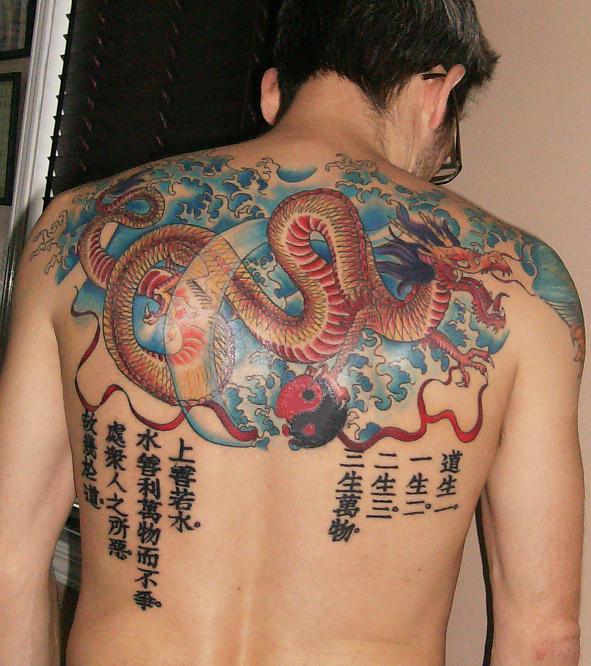
I have my entire back tattooed. It was a 25 hour ordeal.
It was painful. There was one point that I began uncontrollably shivering. My body was going into shock. But I would not use the word 'suffering' to describe this experience.


When I tested for my Black Belt in Taekwon-do, I could describe it as painful. It was a brutal three and a half hour experience that pushed me close to my physical and mental limits. (And incidentally, it was during this examination that I inadvertently stumbled across my first taste of mindfulness. I was previously aware of it, but being aware of it by definition and experiencing it are drastically different).


And finally there's childbirth. Although I have experienced childbirth twice, I cannot say I've experience the pain of it. However, my wife doesn't describe the experience as suffering. There was no suffering. Pain, yes. But suffering? No. I think it is because there is purpose and hope present. At some level I think we instinctively understand that these pains are normal and maybe even necessary.

Although I could continue on about experiences of suffering without pain, I'd rather stay away from that darkened avenue.

Pain is an unpleasant sensation.
Suffering is a mental and emotional response.
Pain is an inescapable part of life as we know it; it is inevitable.
Suffering is optional.
It is the delusional belief that we deserve to live life pain-free that is the cause of much of our suffering.

Pain and suffering are so closely related in our minds - in our beliefs - that when pain arises we usually respond immediately with resistance. We respond with resistance because we believe pain shouldn't happen to us. That belief we cling to is a source of suffering. The greater we struggle with the undeniable presence of pain, the greater our suffering. It is that belief which causes us to become delusional as it is inconsistent with reality.

Alongside our delusional denial of pain is also our denial of death. Few people really give this dreadful topic much thought. We don't want to die: in fact a great many people I know build their entire belief-system or faith upon its denial.

I really like Lin Yutang's shocking biblical interpretation of God's intention for Man's immortality in his book, "The Importance of Living" (pg. 16)
"God did not want man to live forever. This Genesis story of the reason why Adam and Eve were driven out of Eden was not that they had tasted of the Tree of Knowledge, as it popularly conceived, but the fear lest they should disobey a second time and eat of the Tree of Life and live forever.""
We were never meant to live forever and we never will. Doesn't chasing this golden dream (or red herring?) of immortality, whether it is some form of favoritism  or an earned reward of Heaven for doing or saying the right things make us little more than spiritual hedonists? I'd like to believe humanity has the potential to grow and evolve these altruistic traits without being threatened into obedience or bought with rewards. I'm not saying that a spiritual life doesn't continue after physical death. It's that any position we hold is little more than conjecture - or projection - at best. Because we choose to believe it doesn't make it true. But it does affect how we live our lives.Our compassion becomes highly suspect and conditional and maybe even self-serving. Doesn't this contribute to the suffering of the world?

In the various mindfulness traditions I think there's hope.

Suffering occurs when the mind responds negatively to the sensations it identifies as pain. The key to diminishing the suffering that we usually connect to physical pain is acceptance. Acceptance means confronting unwanted pain without hatred and especially without fear.fear. And this acceptance also means a willingness to abandon some of our beliefs. To allow room for a faithful doubt, rather than a doubtful faith.

The moment we attempt to make our beliefs fact is the moment suffering begins. It can only give birth to anger, fear, panic and disillusionment and strengthen the fetters that bind us.

I don't think there's anything wrong with having beliefs, so long as we acknowledge them for what they are and are not. (Simply beliefs, not facts).

It is when the Ego attaches itself to our beliefs that we wade into trouble.