Showing posts with label Pluralism. Show all posts

Sunday, October 12, 2014

Returning to the Torn Veil

What does returning to the Torn Veil look like?

Modern day Western religions all have 2 sacred cows in common.
Membership (or proselyting) and tithing. (It's ironic that Jesus – through the Torn Veil – attempted to break or do away with these things).

We face a few difficult challenges and obstacles here.
Firstly we (collectively) must admit that part of the human condition includes Spirituality. No, not necessarily Religion. (There's a difference). Atheism is a knee-jerk reaction (and rightfully so) to Religiosity, but never-the-less just as unhealthy as Religiosity.
Atheists too have their Spiritual aspects or facets, although many are unwilling to admit it, or will choose not to label it “Spiritual”.
This is the first challenge and obstacle. Collectively admitting that Spirituality is a Human Condition.

This 'knee-jerk reaction' is to what we understand religion to be; namely, Western Modern day religion with their 2 (primary) Sacred Cows.
What are its obsession with Membership and Tithing all about?
Well, look at it like this: You want people to either desire or need what you're selling in order to create a revenue-stream.


That's a business model. That's a good Business Model.
But it's a lousy Spiritual one.


Interestingly, if we look at some large Eastern religions, we see something very different. I'll could Buddhism and Taoism. (I won't use Hinduism because, although its population or numbers are very high, it's extremely concentrated in specific geographic locals).

Now, to be fair - especially for those naysayers and those who simply love to be right and refute others - if you want to throw stones at Buddhism and Taoism there is plenty of ammo. Both are very old religions. Taoism has really two facets. What I'll call Folk Taoism and Modern Taoism. Fold Taoism is where you'll see the stories of gods and Divine people and the like. Mythology to be sure. Same goes with Buddhism. What further complicates matters is that Taoism (for example) is not structured like Western Religions and often doesn't make sharp distinctions between these two aspects. My point being, if you want to throw stones, there's plenty to throw.

But, a few points worth noting are that these two religions do not focus on proselyting, evangelizing, or membership. They are not built upon the Business Model. There's build upon a Spiritual one. (I believe that in our Western worldview and values, we have left Capitalism run amok).


In fact, the Dalai Lama says to “Stay in your own religion and mediate”, not to convert to Buddhism. Not only is this not proselyting, it is its very opposite.


Taoism promotes simply finding truth. 
Because things in the world change, there is no reason to hold tightly on to any reaching or establishment that began tow or three thousand years ago. Only the helpful principles that were taught should be followed, because principles do not change. All good principles can merge together as one good unified principle that exists prior to any of the momentary teachings that were developed." Master Hua-Ching Ni

These are not about building Empire, the growth of membership, or the amassment of wealth.

Two other (lesson) sacred cows Modern Western Religion hold onto are Doctrine and Self-identity.
The 'big' Western Religions (among others) focus on self-identity. If you are a Christian, then you are a Christian. You must self-identity as such. As with Muslim, as with Jews.

Not so with the Eastern.
Both Confucianism and Taoism complement each other, however incompatible they seem at first to be. The former places a man in his proper relation to his fellow men, the latter in proper relation to nature. A third philosophy, Buddhism, though introduced from India, deals with the problem of human suffering and with man's ultimate destiny. These three inheritances... have moulded the thinking not only of the Chinese people but of all Eastern Asian. There is truth, then, in the common saying that every Chinese wears a Confucian cap, a Taoist robe, and Buddhist sandals.Arthur W. Hummel, Former Head, Division of Orientalia Library of Congress, Washington, D.C., 1962, Forward to the Tao Teh Ching.


There isn't this obsession with self-identity as there is in the West.
(Ask yourself, could a Westerner readily claim to hold Christian, Muslim, Jewish values; a sort of Freelance Monotheist? Well, few do, but they aren't openly accepted. They're always accused of sitting on the fence).


The secondary minor Sacred Cow Modern Western Religion holds onto is that of Doctrine.
Although Doctrine is often held to be the glue that maintains truth, order, tradition, and structure, it sadly is not the case. It also includes inflexibility, stagnate growth, control, and simply being right; defending one's position at the expense of the truth.
Doctrine” begins in a position of having a truth and then defending it, rather than legitimately discovering and exploring the truth.
One starts at the end hypothesis and moves to defend it, while the other begins without the hypothesis and move to discover and explore it.

There's a drastic difference between these two actions. 
The "Doctrine-paradigm" sees truth backwards. It doesn't really allow for its exploration. 

The Buddha provided examples and a framework to test his teachings. Nothing was expected to be taken at face-value or carte-blanche. 

Taoism holds onto what I call Zero-Doctrine. Again, a focus on mental flexibility. 

My point in all this isn't to sell Eastern Religions, but to provide a contrast. A measuring stick to hold up against Modern Western Religions. A mirror of sorts.
What does exploring The Torn Veil really look like? I think we need to begin by looking far to the East.


Sunday, August 31, 2014

Misconceptions

A friend, and significant spiritual influence, of mine recently began asking questions of some old posts/ideas of mine.

The final question asked in The Christian Criterion: Lines of Division was, what exactly was the core teachings of Jesus.
I think this links itself to a much older question I once posed in Repairing the Torn Veil.

You really cannot make the claim of being an adherent to the teaching of Jesus without having a clear definition - and understanding - of exactly what it was that he taught. (And as the lesson of Matt Mikalatos' Imaginary Jesus hopefully has taught us, we are extremely subjective when it comes to this issue).

If we look at the four gospels exclusively (I want to keep this simple) what we see is a man performing miracles, and miracles occurring around this same man. (This is an important distinction).
I hope we can agree that - at the least - he was a great wisdom teacher.

I don't want to get bogged down into the arguments of whether he was divine or an incarnation of God, or the unique Son of God. I think this is missing the point, and if this becomes the main point, I believe we've totally lost our way.

I want to strip this down to the bare bones. I think we can agree, as a lowest common denominator, that he was at least a great wisdom teacher.

He taught through parables (and let's remember, the parables were a teaching tool, not the teaching itself). He taught (sometimes) through example, and he taught (or the recorders of these events) taught through symbolism.
But what did he teach?

From the context of Old Testament Judaism - he was Jewish and he was a rabbi - maybe a heretical one - but a rabbi never-the-less.
This cannot be ignored and this cannot be viewed through the modern day Christian lens.

~

I think some very common and fundamental terms need to be reviewed here.
The concept of "Holy", "Sin", "Sheol" (Hades?), Hell's prototype Gehenna, and even the afterlife to name a few.
"In the Hebrew Bible there is no eternal afterlife, only the survial of your name/culture/nephesh (meaning breath, life-force, spirit) through children. This is why we have the commandment to honor your mother and father; because by ignoring or forsaking them you effectively put a permanent end to their identity and heritage. Barrenness, the inability to conceive a child, meant a couple's total extinction, eradication from history." J. Snodgrass, "Genesis and the Rise of Civilization", pg. 135
The Old Testament held little to no concept of an Afterlife. Certainly nothing like modern day Christianity does.

It was an unclear, fuzzy idea at best. They held the idea of Sheol, an abode of the dead. Not a Hell of Eternal Conscious Torment, or even of suffering. Both the righteous and the morally corrupt went to Sheol. There was no moral judgement.
In fact, the concept of Sheol was very similar to the Greek concept of Hades. These were not Hell.
In Edward W. Fudge's "The Fire That Consumes", chapter 6, section "Sheol in the Old Testament" (pg. 81-82) we see this fleshed out in detail.

Even Hell's prototype, Gehenna, wasn't the Hell of Eternal Conscious Torment either.
"It is fair to say... Gehenna would convey a sense of total horror and disgust. Beyond that, however, one must speak with extreme caution.
"It is commonly said that Gehenna served as Jerusalem's garbage dump, "a necessary hygienic incinerator outside the walls"... Here the fires burned day and night, destroying garbage and purifying the atmosphere... In times of war the carcasses of vanquished enemies might mingle with the refuse... they were destined to be destroyed in the fires that were never quenched". Edward W. Fudge's "The Fire That Consumes", pg. 161-162
What we see is a reference to a very real geographical location anyone listening to the story would readily know of. No different to the local dump just outside my city. I know where it is. I know what it is. I could even go there and see it if I wanted to.
It was a parable and teaching tool that took on a life of its own and seems to have became something it was never intended to be.

Again, viewed through the lens and context of Old Testament Judaism, we do not find any sort of Hell of Fire and Brimstone and judgement.

...and what of the Holy and the Sinful?
"...we must be very cautious about assuming we know what "Sin" means in this context, or in any." J. Snodgrass, "Genesis and the Rise of Civilization", pg. 157
 Too often, we have been told/taught that Sin is somehow linked or associated with sex or desire or the like.
"The Sodom story is sometimes read as a "proof text" against homosexuality. But what these men are proposing is not consensual gay sex, it's gang-rape: forcefully and deliberately tearing away someone's dignity. Sex is not the crime they're punished for - the crime is abusing a guest
"The "sin" of Sodom is not sodomy, it's inhospitality." J. Snodgrass, "Genesis and the Rise of Civilization", pg. 158
But I think it's Marc Gafni who puts its clearest and best,
"In the original, "to sin" does not mean to be bad. It means literally to miss the mark... To sin is to miss the mark, to not properly understand the nature of reality. Sin is a form of ignorance, a false or partial relationship to reality." Marc Gafni, "Your Unique Self: The Radical Path to Personal Enlightenment", pg. 24-25
And this comes from somewhere and leads to something.
"We shape our God, and then our God shapes us... [if] that God is angry, demanding, a slave driver, and so that God's religion becomes a system of sin management" Rob Bell, "Love Wins" pg. 183
"Sin", from its original context, meant to miss the mark. Not to be morally corrupt or 'bad'.

It is interesting to note that what we today define as “holy” is absolutely not as the Hebrews defined it. The Hebrew word of holy is kaddosh, which does not mean a state of moral perfection nor has anything to do with morality. It means “otherness”, not natural, but supernatural, not of this world, but alien.
Not in the tribal sense of not of our tribe (an outsider), but something so unlike us as to be near incomprehensible.

When we see "Holy", "Sin", "Hell" through this lens, we seriously need to question what Jesus' teaching(s) were. Heaven, Hell, Salvation, all change meanings or become moot.
"Jesus is bigger than any one religion.
"He didn't come to start a new religion, and he continually disrupted whatever conventions or systems or establishments that existed in his day. He will always transcend whatever cages and labels are created to contain and name him, especially the one called "Christianity"
"Jesus is supracultural.He is present within all cultures and yet outside of all cultures.He is for all people,and yet he refuses to be con-opted or owned by any one culture.That includes any Christian culture. Any denomination. Any church. Any theological system." Rob Bell, "Love Wins", pg. 150-151
The symbolism - whether enacted by Jesus himself or whomever recorded/penned the story - of the tearing of the veil is, in all likelihood, the singular most important lesson in his entire teachings - maybe even superseding the crucifixion and resurrection.

What, I believe, we are seeing in his teaching, is, ultimately, the end of religion. All of religion.
But what does that mean, and what does that look like?
I think a good play to start is the following:
"Everyone agrees: we need to wake up... In what way are we asleep, and consequently, in what way do we need to wake up? Each stream of culture, including psychology, spirituality, evolutionary theory and more, answers this question differently... no major stream of knowing is smart enough to be entirely wrong...each claim... is true, but partial... The problem starts when a partial claim to truth claims to be the whole story. When parts pretend to be wholes... the result is cancer in the body or body politic." Marc Gafni, "Your Unique Self", pg. 44 
(This final pic is a link well worth following and checking out)


Sunday, September 15, 2013

The Spiritual Sojourn of the Lay-monks

There would seem to be some sort of mass exodus from religious institutions going on. 
The decline is most prevalent in Europe, less so in Canada, and only beginning in America. 
It seems to be a sort of scale with those who identify with non-religion running parallel.

Europe - Canada - America.
High   -   Medium  -   Low.

And when we consider the rate of decay within the United States of America the direction of this would seem obvious. Formal organized religion is dying.

In Europe its churches are becoming more akin to museums.
In America they're being abandoned.


Many tote this as the success and rise of atheism, agnosticism, and secular humanism.
It almost reminds me of the spiritual equivalent of an Urban Wasteland.

Some would celebrate this as the death of God and spirit and the advent of a new age of scientism. But I think the 'religion' of scientism is dying as well. 
With the decline of official organized religious institutions some might even believe we are seeing the death of religion and spirituality itself.

...maybe...
I'm not so sure though. 
The death of official organized religion as an institution has little or nothing to do with spirituality.

Maybe when organized religion finally gives up the ghost, our innate Spirituality can be free to blossom without the inhibitions of the disease of Religiosity

No, not "New Age" hocus-pocus. No more Plastic Shamans, exploiting us for our money, their ego and power. I think we may be seeing the death of the business of religion.

I believe there are many spiritual sojourners out there. Urban lay-monks that are only beginning to navigate this spiritual urban wasteland left behind by Organized Religion.


They are not leaders of potential new religions.
They're non-centralized. Free. Reflective. Compassionate.
Conditional Grace is no grace at all.
There is no price-tag attached.
There are no conditions to be met.
Come as your are or fuck off.

Maybe - just maybe - we should begin keeping an eye open for them.


Sunday, September 8, 2013

A Map of Humanity

From Lydia's blog, On The Other Hand, comes Suggestion Saturday: September 7, 2013, The World Religions Tree.
Although the more I thought about it, the more comfortable I am with naming it A Map of Humanity.


The above picture is a link. To appreciate The World Religions Tree fully it really needs to be explored in all its minute detail. I've never seen anything quite like it before. My daughter tells me it reminds her more of a brain than a tree.

Although I would have like to see the growth of Atheism and Scientism included, I suppose by strictest definitions they are not proper religions.

After spending the weekend exploring this wondrous map of human-kind's over 6,000 year spiritual and theological journey, you begin to ponder which 'direction' to look at it from. At least I do.

Although I am sure some will attempt to hold the fundamentalist's position, it seems barely worth addressing; that one, and only one of these near-countless fibers is the truth. When I look at this map of humanity, I can not seriously even consider this option. It becomes an unsustainable joke.

But should we focus on the tree's trunk? Do we find a purer form of understanding the divine or truth the simpler we go? Or do we discover an older, less refined, more primitive, folklore, superstition based belief more in magic than science? Travel far enough and at some point we will find ourselves among cavemen.

Or do we look in the opposite direction?
When we look at the tangled fibrous edge of our most modern and current times, what are we seeing? Are we seeing mankind's splintering and division of their ulterior agendas and personal and private goals? Have we become lost in the analysis of the details?
Or are we seeing our collective evolution of over six thousand years, thousands of cultures - many totally isolated from one another - and billions and billions of people? Are we seeing humanity's collective refined perception of the truth?

Like any true "-ology", it becomes based upon previous individuals' work and understanding. It is a progressive system of learning.

I think we stumble across a conundrum.
I believe the answer is right before our eyes, yet hidden in plain sight.

Firstly we need to acknowledge that there is corruption and that there are individuals that are only out for their own good and their own personal agendas present within any and all branches. If we cannot get past this point there's no need to look any further; we've come to the end of the rope. We need to assume (even if only hypothetically) to be able to weed out and keep only the legitimate ("don't throw out the baby with the bathwater").

The problem we face is that we - each and every one of us - can only ever be a single individual. And as a single individual we can only see the world from the perspective of the single fibrous strand our culture, our background, and our beliefs come from. (and that includes atheists as well).

The richness of this map of humanity is lost on the individual.

It is only when we attain the willingness and ability to step outside our culture, our background, our belief-system, our truth - outside of our fibrous strand - that we can even begin to appreciate the absolute majestic and grand scale of our collective human insights.

Ultimately the question is, are we suffering from division and splintering, or are we progressively refining how we perceive the truth?

Personally, I tend to learn towards the latter.


Saturday, June 15, 2013

The Mu Portal

The Dharma Entanglement is blocked by the encircling Ego.
We are entrapped by our Ego.

Ego is fabricated by three elements; Delusion, Envy, and Fear.
Dharma, Solace, and Compassion compose The Dharma Entanglement and our innate Wu Wei Nature, for Dharma emancipates us from Delusion, Compassion from Envy, and Solace from Fear.

The way forward through these blockades and barriers of the Corporate and Private Ego is through the Mu Portals.

~ ~ ~ ~ ~ ~ ~ ~ ~

The heretical Rabbi, Yeshua of Nazareth, spoke of a strange and elusive concept he called The Kingdom of God. Something that was yet to come, yet strangely present in the Here and Now; within ourselves (Luke 17:21). An unrealized potential.

Yeshua was an exemplar; he was a Revealer rather than a Redeemer. It is religion, religiosity itself that kept us ignorant, captive, and slaves.

What I believe Yeshua truly taught wasn't the advent of new religion (Christianity), but a heightened awareness - a sort of freedom and enlightenment, rather than a salvation. Yeshua's Kingdom of God wasn't a new religion, but the end of all religion. The escape hatch from this Edenic Birdcage; emancipation from the Entrapment of Religiosity itself.


~ ~ ~ ~ ~ ~ ~ ~ ~

Mu is Japanese for “not” often used as a prefix, but can stand alone, simply as 'not'. It can mean to “unask the question", suggesting that the problem does not lie within the answer (there is no correct answer), but within the question itself. The problem needs to be approached from another point of view. I think this gateway is critical to one's spiritual journey. Without it, it is simply stagnation. Growth becomes impossible. The entrapment of religiosity remains unbroken.

Although there could be many possible paths to the Dharma Entanglement, ultimately I believe “Mu” is a necessary gateway to escape the shackles of Religiosity and enjoy the emancipation of Spirituality. (Only then can Spiritual Solace be realized, cultivated, and nurtured).

I think this may very well be the defining difference between the Religious and the Spiritual; parting ways from the disease or plague of religiosity. Abandoning these slave masters.

I have found many monotheists, as well as many Atheists, lack a healthy sense of Doubt, and suffer from an addiction to Certainty. And when we fall victim to the Certainty Addiction everything becomes a matter of knowing and fact and proving one's beliefs. Faith dies. Truth takes a back seat to being Right. Thus enters the hidden and silent inner conflict. Combine this addiction with inner conflict and the monotheist's concept (fear) of Damnation and their Solace's destruction is complete.

What we need to discover is our Mu Portal. Not only an exit point from our own dependencies on religiosity, but the knowledge and wisdom to realize that our religiosity is not only unneeded, but the one thing that kept us captive. It is the only way to attain Spiritual Solace and growth. It is our only way to break Fear's grip.

Mu” (regardless of which avenue one arrives here or even by which name one recognizes it as) is the ability of simply 'letting go' and be at peace with not-knowing. What is important is the meanings and the lessons and the wisdom that are behind these myths, images, and symbols. These stories can be just as true for the Atheist as they are for a Christian or Buddhist or a Muslim or a fill-in-the-blankAllowing a Faithful Doubt (rather than a Doubtful Faith) and living at peace with its mystery. Something many religious people (especially institutional religions) struggle with.

The Mu Portal doesn't belong to a specific religion or spirituality or tradition. All traditions have their Mu Portal(s) and they're not limited to one each. There could be as many Mu Portals as there are people. They may look drastically different and their purpose is not necessarily to deliver away from their individual religion, faith or tradition.
(But most often, I should imagine, it would drastically open one's eyes; rather seeing it as an exit from their religion or faith or tradition, they may prefer to see it as moving beyond it).

The Mu Portal frees the individual from the confines and entrapment of religiosity.
I believe a great many people never find the Mu Portal and never seek it.

I believe some, discover or stumble across it. Their first experience with it would be extremely confusing and terrifying – causing them to flee into the perceived comfort of the familiar and structured and established. Many will never revisit it again.

But some, even as frightened confused and wary of its extreme alien-ness, will sense a truth and an attraction to it and be slowly drawn back.

It won't make sense. It can't. By its very nature it is incomprehensible from the context it is being viewed from.

It is a spiral stairway with no banister or railings on a space station.
Without the railings there's no support structure, no guiding rules or regulations. Without the banister there's no safety; no protection from falling.
It isn't until you realize in 0-g you can't fall but only float.

It's difficult and challenging to understand this because of the context you were always taught to view things from. That is the nature of the Mu Portal.

It is both an Inner and Outer Journey.
To break free of the Edenic Birdcage, the Confines of Religiosity; to pass through the (1st) Mu Portal is to escape from the Corporate Ego. (This is the Outer Mu Portal).

The second Mu Portal (inner)delivers one through their Personal Ego and into The Dharma Entanglement and to their true and innate Wu Wei Nature.

But it is vitally important to remember, what I speak of belongs to any and all traditions. I use some Taoist, Buddhist, and Christian terms (and even some I've been forced to name an label myself), but I am only capable of seeing this from my own experiences and attempting to express it from my own point of view.

Our innate Wu Wei Nature - this Dharma Entanglement - will be known by many other names and experienced in many different ways. Our Corporate and Private Egos will be known as something different as will out pathways and 'escape hatches'. Our passing through the Mu Portal will look like hundreds of different stories.

The last thing a corporate entity - an institutional religion - will allow is the escape of dependency upon itself. Of course most traditions don't speak of it, nor name it, or acknowledge it. It is the reason Yeshua was killed. It proposes the end of all religion. It is not important what we call it. What's important is that you acknowledge the Mu Portal's existence. 


Sunday, May 12, 2013

Irshad Manji's Ijtihad


I have fallen in love with Irshad Manji's concept of ijtihad presented in The Trouble with Islam.


The third source, or root, of Islamic law is called ijtihad (“responsible individual opinion” or independent reasoning). It has been used when an issue was not covered by passage in the Qu'ran; a jurist may then resolve the issue by using analogical reasoning. Such reasoning was first employed when Islamic theologians and jurist in conquered countries were confronted with the need to integrate local customs and laws with the Qu'ran.

It led to the Golden Age of Islam. The Muslim principle of ijtihad (independent judgment) should encourage and be receptive to new ideas. The Qu'ran itself demanded constant revision and self-examination. (Although it is obvious that much of Islam today has lost or abandoned this). Knowledge was not simply a matter of acquiring information but a process of transformation.

There was emphases on the unity of truth, which must be sought everywhere. A seeker after truth must shun no science, scorn no book, nor cling fanatically to a single creed. However, this form of ijtihad existed in the Golden Age of Islam and has unfortunately been abandoned by most Muslims, resorting to indoctrination over education, blind-faith over thoughtfulness. (It is unfortunate that the Gates of Ijtihad have been closed). 

I believe it is the 'moderate' Muslims of the world that need to reclaim Islam back the from extremists. There needs to be some sort of reformation within it. Maybe the gates of Ijtihad need to be reopened.

There would seem to be a crossover in 1 Thessalonians 5:21, where it says, “Test everything. Hold on to the good.” Sounds a lot like placing emphases on truth, which must be sought everywhere. A seeker after truth must shun no science, scorn no book, nor cling fanatically to a single creed

I think there is a good lesson and a great richness to take from ijtihad.

Ijtihad is something I'd like to learn more of and incorporate into way of life. In fact, to some degree, I already have.

Friday, May 10, 2013

A New Axial Age for an Uncharted World


We are entering a new and uncharted world. A spiritual world some might argue; a world in which answers are desperately needed. And for the first time since the Enlightenment, a world in which science cannot provide all the answers.

Are we equipped for this new journey of exploration?

I think there is a certain wisdom to be learned from the Atheist. They clearly see the problems with the fundamental-mindset and lack of open mindedness and prohibition of doubt and skepticism present within some of the world's great religions. (They also, often in error, assume these are necessary prerequisites for the religions).


Hinduism, Buddhism, the Chinese-syncretism (Taoism, Confucianism,Buddhism), Judaism, Christianity, and Islam; the great religions of the Axial Age.


No great new religion has swept into world prominence since Islam some 1300 years ago. Does this mean that the foregoing list completes the roll call of living religions? Yes, and no.”

If we accept Emergence Theory, the existence of cultures and religions are a fluid and evolving thing. It may occur in leaps and bounds and the Axial Age may very well have been a leap or bound, but it cannot be the final word. It cannot be the final step. What will be the next step in their – or indeed, our – evolution?

Through the centuries men have died for the right to believe, but other men equally sincere have died for the right to disbelieve. However we may rate their wisdom, we must credit them with a kind of religious fervor in defense of their faith. For atheism too is a faith, in the sense that it is based on belief rather than scientific proof.

In its narrowest sense the term atheist means one who denies the existence of any and all gods. But it has come to apply to those, including skeptics  materialists and positivists, who do not acknowledge that the world was created by a being or beings of incomprehensibly magnified human intelligence and form, and also an uncounted number of people the world over who would consider that they fit the word's broader implications.

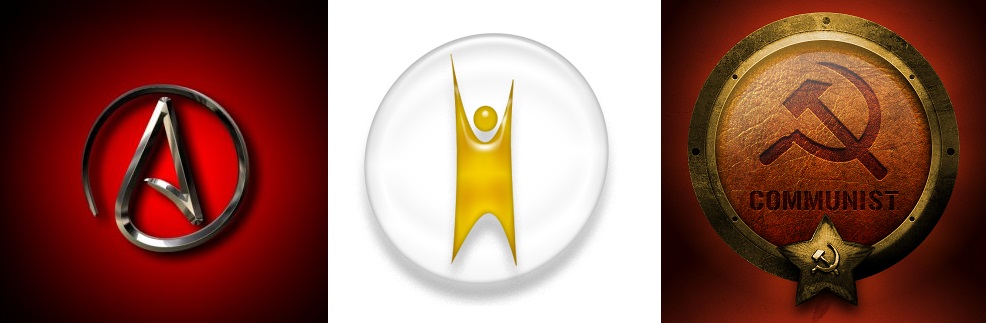
Since pure atheism and agnosticism obviously do nothing towards answering the ultimate riddle of life, some nonbelievers have turned to humanism – a term which has had many varying meanings, but which today, according to Corliss Lamont in Humanism as a Philosophy, “is the viewpoint that men have but one life to lead and should make the most of it in terms of creative work and happiness; that human happiness is its own justification and requires no sanction or support from supernatural sources; that in any case the supernatural, usually conceived of in the form of heavenly gods or immortal heavens, does not exist; and that human beings, using their own intelligence and cooperating liberally with one another, can build an enduring citadel of peace and beauty upon this earth.

And finally there has emerged in contemporary history another great power over men's minds and acts – indeed, a faith – which is at once the denial of all religion and the most potent expression of secular religion ever to challenge the other faiths... Communism.” The World Great Religions, Time Incorporated, New York, 1957, pg. 8

Does our modern age contain within itself a New Axial Age?

I don't see issues with Atheism as an alternative Belief-System, but we have seen the rise of Atheist-fundamentalism, and I do see issues with this 'flavour'. It is the last thing we need.

We also have seen the birth of Humanism (and it's darker brother, Communism).

I think another hallmark of our potential modern Axial Age is a sort of pluralism, or syncretism of faiths. And this gives me hope. I think it's important that we acknowledge and identify their existences. Yes, we have historically seen syncretism in the past, with the Romans and much of Hindu's numerous millennial spanning life is a testament to syncretism. But what is unique today is that we exist in a global society – we live in a much smaller world.
The option of a fundamentalist position now,can only lead to Empire or destruction. And isolationism is no longer an option.

In the New Axial Age, can Pluralism, the New Religions of Atheism, Scientism, Communism, and Humanism (in their various forms) find their place in an ever shrinking global community?
Will they sow the seeds of conflict and destruction? Will they become akin to the religions they so hate by competing for power, human resources, and authority?

Or could these be the tools we need to navigate into this new world?
Personally, I'd like to believe in the latter.

Saturday, April 20, 2013

"Unique Self" Dialogue with Mike Morrell and Dr. Marc Gafni

I'm not going to be able to thoroughly comment on this entire dialogue. There's a significant amount of information to digest and absorb, so I'll restrict myself to certain points that stood out to me and caught my attention.
But first allow me to comment on how this brief (one hour) conversation affected me personally.
"Emergent Theory necessitates including that within itself which it evolved beyond"
It has been a long time since I have stated (5-1/2 years) that I have moved beyond Christianity, having experienced its - possibly forced - limitations. However, having listened to Mike Morrell an Marc Gafni's conversation has caused me to, at least entertain, rethinking this position. Maybe, as the definition of Emergent Theory states, by moving beyond, by spiritually evolving beyond Christianity, I have not abandoned it, but absorbed it. Maybe it is still within me, but I have forgotten. Maybe it is something I would be wise to reflect upon and remember.

~

I can remember reading John Hick's God Has Many Names and The Metaphor of God Incarnate, he had identified the challenges faced with find some sort of bridge between many of the non-theistic Eastern Traditions and the Abrahamic Faiths.

The comments about Being (from Easter Traditions) and Becoming (from Western Traditions) are clearly symbiotic. Being and Becoming are one another's strength, and this could very well be that elusive 'bridge' between the non-theistic and theistic traditions.

~

When Mike Morrell has asked, how do we engage in 'my unique self', the first point Marc Gafni suggests is that we need to read - that the art of reading was lost.

I don't believe Marc could be more correct.

Many years ago, when I was still affiliated with a church, I had did a survey regarding how much people in general read. The question was simple. Not including memos, emails, traffic signs, short texts, anything required for work, newspapers or magazine articles, how many books do you read in a year?
I asked 100 various people I knew in my community (admittedly, not the best size group for a survey, but I was only one person). I suspected the numbers would be low, but I didn't expect what I encountered.

86% said they read between 0 to 1 book a year, and 12% read between 2 to 3 books a year. That's 98% of people read less than 4 books a year.
Clearly, reading is a dying art.

Shortly after, I figured I would do the same survey but this time with church-going Christians only. I figured - due to bible reading - these numbers would be higher, and potentially the art of reading would be alive and well within the church-going Christian community. At least that was my expectations. And once again, reality surprised me.

Slightly over 60% didn't respond at all. To this day I'm still not sure what to think of this. Indifference? Who can say.
The sad truth of the matter is that, like Marc Gafni said, reading is a lost art. One we need to reclaim.
Many people are surprised to hear this. Many people I share this story with initially confuse the ability to read vs. the actual act of reading, believing - I suppose - that being literate is synonymous with reading. They're not the same.

~

The second point Marc Gafni said was to ask oneself 5 questions (And I'll add my initial thoughts about myself as we carry on forward):

  1. What is my unique pleasure? (Bringing abstract and creative ideas and thoughts to fruition).
  2. What are people most naturally dependent upon me for? (To be the voice of reason in a sea of emotional chaos - maybe that's more of a statement about the people around me than of myself?)
  3. What is the unique need that I can address for people within my circle? (Analysis and order)
  4. What is my unique talent?
  5. What is my unique Shadow?

I believe my 'unique talent' and my 'unique Shadow' are one in the same thing.
Imagination.
(And let's make a note of distinction here; man's innate ability of Imagination is not the same as Make-Believe or pretending. Our innately human faculty of imagination - though can be used to make believe and pretend - is also our tool in dealing with abstracts).

It is both my blessing and my curse. My Imagination opens up wonder vistas  and allows to me see the patterns and order of things within the parent chaos. But on the same note, my Imagination gives birth to and feeds energy to my Fear and Worry. My Fear is great.

~

Dr. Marc Gafni said, "We need Christianity"
Christianity needs to evolve itself from within its own tradition. These are extremely powerful words. These are words of hope!

He says that Progressive Christians (Emergent?) must reclaim their moral authority. Not give up, not abandon Christianity, but passionately embrace it.
...I couldn't agree more...
...but how? The current Christian 'moral authority' exists within the Institutional Church.
I have always seen these 'Progressive Christians', like Mike Morrell, or Emergent Christianity as a sort of misfit fringe-dweller. But the very structure, business-like model of the modern day Institutionalize Church carries the entire moral authority. It is built (man-made?) that way. It's not just that these fringe-dwellers  are not yet a majority - or at least at that magical 'tipping-point' number - but by their very definition are not centralized; cannot be centralized; I doubt can every become centralized within becoming yet another denomination or splinter group.

~

This dialogue was extremely engaging and has piqued my attention unlike it has been piqued in quite some time.
I anxiously look forward to getting a copy and reviewing Dr. Marc Gafni's Your Unique Self from Mike Morrell's Speakeasy.


Coming soon,
"Your Unique Self" by Dr. Marc Gafni, Commentary and Review

Sunday, February 3, 2013

Evil Fruit and the End of Religion


The Abrahamic God

Abraham is the father of three major world religions: Christianity, Judaism, and Islam. Could these “children” be related? Abraham was blessed by Melchizedek, priest of the Most High God. Who is the Most High God? Could this Most High God be the Abrahamic God of Christianity, Judaism, and Islam? What happens when a Christian, a Jew, and a Muslim all pray to God? Do they all pray to the same God, and does He hear all their prayers?

The fact of the matter is that Jesus only met the messianic criterion of Priest by being of the order of Melchizedek and thus a priest of the same Most High God – not a priest of one people, the Israelites, but a priest of all people. I believe many Christians fail miserably in recognizing this point, believing they have a monopoly on God.

We are brought back to this question. How do we discover and follow - not the God of a single people - but the God of all people? How do we know and follow the Most High God?


We may very well be off the mark. In Luke 2:29-32 it clearly states that this Saviour is not exclusively for Israel only, but for all people – again tying into the idea of Jesus being a priest of the order of Melchizedek – a priest for all people.
Sovereign Lord, as you have promised, you now dismiss your servant in peace. For my eyes have seen your salvation, which you have prepared in the sight of all people, a light for revelation to the Gentiles and for the glory to your people Israel.
 But this passage from Luke also states that He is to be “a light for revelation to the Gentiles” which is showing them the correct way and not necessarily representing them. However in John 10:11-18 (specifically 16) Jesus states something interesting:
”I am the good shepherd. The good shepherd lays down his life for the sheep. A hired hand will run when he sees a wolf coming. He will leave the sheep because they aren't his and he isn't their shepherd. And so the wolf attacks them and scatters the flock. The hired hand runs away because he is merely hired and has no real concern for the sheep. I am the good shepherd; I know my own sheep, and they know me, just as my Father knows me and I know the Father. And I lay down my life for the sheep. I have other sheep, too, that are not in this sheepfold. I must bring them also, and they will listen to my voice; and there will be one flock with one shepherd. The Father loves me because I lay down my life that I may have it back again. No one can take my life from me. I lay down my life voluntarily. For I have the right to lay it down when I want to and also the power to take it again. For my Father has given me this command."


He is not just the Son of God, but the Son of the Most High God. Like Melchizedek, He is a priest (representative and mediator) of the “Most High God” – the God of all humanity. (Hebrews 7:1-28). This most definitely states that the God of Jesus' purpose is beyond that of only the Jews and beyond that of what will become only the Christians.


However the story of Jesus and the Faith of the Cananite Woman (Matthew 15:21-28) would seem to suggest quite the opposite. In verse 24 Jesus quite specifically states that “I was sent only to the lost sheep of Israel”. Which would seem to contradict this. How can we make sense of these statements? I find that in the analogy of the vine (John 15:1-2) can we make some sense:

“I am the true vine, and my Father is the gardener. He cuts off every branch in me that bears no fruit, while every branch that does bear fruit he prunes so that it will be even more fruitful. “

“…while every branch that does bear fruit he prunes so that it will be even more fruitful.” The use of the word “every” is more than suggesting a plurality. Is Jesus saying that there could be more than one branch? Most definitely, but is He saying that these are individual people or various “ways” or beliefs? Is He identifying multiple faiths and religions? Again, this is not clear. However, if we take this vine analogy and view it in the context of a family tree we find some interesting results.


When we view the “family tree” of Israel, Jesus’ statement from Matthew 15:24 (“I was sent only to the lost sheep of Israel”) takes on new meaning. The “lost sheep” of Israel becomes Jews (and eventually Christians) as both are from the “branch” of Israel. However, with this train of thought Muslims are not of the “branch” of Israel, but of Ishmael. But are not both children of Abraham? Could this be the “other sheep not of this sheepfold” (John 10:16)?

Ultimately it becomes an issue of whether the importance lies with a “religion” or faith being of “Israel” or of Abraham. There would seem to be evidence to support the value of being a monotheistic Abrahamic “faith”.

I believe Jesus, being a priest of the order of Melchizedek and representing man to the Most High God includes Judaism, Islam, and Christianity. I believe all have suffered serious corruption by the hand of man over the centuries.

Evil Fruit and the End of Religion

Beware of false prophets, which come to you in sheep's clothing, but inwardly they are ravening wolves. Ye shall know them by their fruits. Do men gather grapes of thorns, or figs of thistles? Even so every good tree bringeth forth good fruit; but a corrupt tree bringeth forth evil fruit. A good tree cannot bring forth evil fruit, neither can a corrupt tree bring forth good fruit. Every tree that bringeth not forth good fruit is hewn down, and cast into the fire. Wherefore by their fruits ye shall know them. Not every one that saith unto me, Lord, Lord, shall enter into the kingdom of heaven; but he that doeth the will of my Father which is in heaven. Many will say to me in that day, Lord, Lord, have we not prophesied in thy name? And in thy name have cast out devils? And in thy name done many wonderful works? And then will I profess unto them, I never knew you: depart from me, ye that work iniquity. Matthew 7:15-23, KJV
Wherefore by their fruits ye shall know them [false prophets]. Jesus gives direct instruction as to how to identify “false prophets”. Ultimately it is not by their words or teachings but by their actions and the results (fruits) of their actions. This forces us to carefully examine certain issues:

Islam has produced the Islamic extremist terrorists (who do not even follow the Quran 2:178 and 2:190. These verses clearly states that God does not love those who overstep the limits and that grievous suffering awaits those who do). So can we therefore say that Islam has produced “evil fruit” and condemn it to the realms of false prophets? There is some truth to this but it is somewhat of a blanket statement. The Islamic extremist terrorists are really not true Muslims, but nevertheless are still “evil fruit” of Islam. If we are to adhere to Jesus’ definition of “false prophets” and apply it to Islam, then by these same definitions we must begin looking at other religions.

Christianity has produced the Inquisition, the Crusades, and the overall eradication of the Central and South American Indians and the warfare and “conversion” of the North American Indians. The sexual abuse and pedophilia of the modern day Roman Catholic Church. The embezzlement and lying of certain Christian televangelists. There is no shortage of “evil fruit” in Christianity. And before we use the excuse that these were acts of individuals and not reflective of Christianity as a whole we need to revisit our thoughts and opinions of the previously mentioned Islam Extremists. I believe Christianity has produced “evil fruit” . I also believe that Jesus had no intention of beginning a new religion. If asked the question, Was Jesus Christ Christian, the answer would be, no.

Atheism (as a belief-system) has produced the Nietzsche-like belief or philosophy of the Nazi-party whose fruition was a World War and The Holocaust. I would very much like to meet an individual who would seriously state that this was not “evil fruit” .

Judaism becomes an interesting religion when viewed from this point of view. As mentioned in The Flawed Priesthood , it is not incorrect to say that Jesus was Jewish, neither is it completely true. Jesus was a Jewish heretic. Jesus systematically “disassembled” the Jewish priesthood and threatened its very foundation. It is obvious that Judaism was “off course” and in need or correction.

The genocide that the Israelites committed under the leadership of Moses (primarily in the book of Numbers) is most definitely questionable. The “commissioning” and building of idols (Nehushtan), the practice of animal sacrifice, the very existence of an elitist priesthood, and the aforementioned genocide should be highly suspicious and questioned as the product of “evil fruit” .

By Jesus’ own teachings and definition of “false prophets” Islam, Christianity, Judaism - and even Atheism - have all produced “evil fruit”.

I suppose - ultimately - the Pluralist believes all spiritual paths lead to God/Being itself/monistic substrate/Universal Consciousness/Ultimate Reality - call it what you wish - that all these traditions and paths are valid.

There are many days I think I'm a Pluralist because I believe there is invaluable wisdom within the great many beliefs and traditions out there... but I'm not sure this is correct. I believe there is a great wisdom within the people of these many beliefs and traditions.
I have come to see the great three Abrahamic traditions (not its people) as institutional branches of the same tree.
"No tree has branches so foolish as to fight among themselves" Native American Wisdom
Not only have I moved beyond Christianity  but I have moved beyond that Abrahmaic faiths/institutions and abandoned the (concept of the) Abrahmanic God.

If all have produced “evil fruit” then what exactly is Jesus teaching? If none of these are correct or the truth, then what is the truth? The only conclusion I can come to is that Religion itself is “evil fruit” and as such Jesus’ teaching was not to create another religion, but to end all religion.
“If the cross is the sign of anything, it’s the sign that God has gone out of the religion business and solved all of the world’s problems without requiring a single human being to do a single religious thing. What the cross is actually a sign of the fact that religion can’t do a thing about the world’s problems – that it never did work and it never will…” Robert Farrar Capon, “The Mystery of Christ…and Why We Don’t Get It”, pg. 62

Tuesday, January 15, 2013

"The Enoch Factor", by Steve McSwain

(By Guest Blogger - Michel Weatherall)

The Church has lost touch with it's founder, having embraced a religion about Jesus, rather than the religion of Jesus. “The Way” was the religion of Jesus. The later religion about Jesus is what we know today as Christianity.

The Christian Church has become the modern day equivalent of the legalistic and rule-orientated Pharisees of Jesus' day. “Believers are told what to think, how to believe, and the way to live. Furthermore, most church leaders disregard the fact that their founder repudiated the religious leaders of his day for doing this to the followers of Judaism”. (pg.45)

One startling fact is that “in the last ten years... it is estimate that Christian churches have spent more than $ 100 billion on buildings and facilities. In that same time, more than 400,000,000 people have died of hunger on this planet”. pg.46

What would Jesus do?

The future of the Christian Church, with its members leaving in droves, is definitely in question. Its death is near inevitable.

Unless we can collectively abandon our desperate ego-driving pretension of spiritual certainty, Humanity's future itself is also in question. Steve McSwain words echo that of the Dalai Lama. (“Until there is peace among the religions of the world, there will be no peace in the world”).

I like nearly everything Steve McSwain has to say. I especially like the fact that “The Enoch Factor” isn't attempting to re-market or repackage the old stagnant religion of Christianity; to identify the demise of the modern day church, yet selling its same flawed values.
Truth be known, I believe this direction is the only choice that has any hope for a future – not just Christianity's, but all of us.

His concepts are simple, truthful, yet truly revolutionary.
Funny that word, Revolutionary. Over that past 2 years I must have reviewed at least 5 books to make that claim. None of them were true. “The Enoch Factor” doesn't make that claim of itself, but it most definitely is revolutionary.

His take on certain issues are refreshing, like a breath of fresh air. Better! They're more like a spring breeze that cleans out the stagnant mold and damp of an over-long winter.

His take on the Garden of Eden, Adam and Eve is close if not identical to Rob Bell's (“Velvet Elvis”). He addresses, or clearly defines, what Sin is, or might be. "The word sin means "to miss the mark"... Sin actually means "to miss who you are" - who you really are. It is to be lost in the illusion that you are your ego". (pg. 96). Although he doesn't come out and say it, it is clear Original Sin is abandoned. (pg. 167).He would seem to agree with LinYutang's “The Importance of Living” in that man was never meant to live forever. That death is not punishment for Sin.

"Salvation as it is called in the Christian tradition, or Enlightenment, as in Eastern traditions, is the opening of your spiritual eyes" (pg. 133).
We can begin seeing Jesus' Way as having an unofficial Buddhist take, with Salvation resembling and striving to attain the perpetual "Now", with escape from the regrets of the past and the anxiety of the future. 

Sin, Creationism, Salvation; McSwain's underlying point isn't to argue and debate these beliefs. His underlying point is our collective freedom from sin, our escape from Ego.

This book should force Christianity to question our man-made religion about Jesus, and much more importantly, begin our exploration of the religion of Jesus. Everything we believe we know and understand can be viewed anew.

This book isn't about Christianity. This book has further reaching ambitions. The author himself admits that he must tell the story through his own medium; his own culture and that is a Christian one. But do not be mistaken. This book isn't exclusively about Christianity. This book is about Humanity itself. It seeks a larger, more encompassing truth and has the open mindedness, tolerance, and compassion to succeed.

The book is littered with various quotes from sources that cannot be called anything but pluralistic.
The Buddha, Krishna, Lao Tzu, Gandhi, the Dalai Lama, Jung, Kierkegaard, Nietzsche, Einstein, Sagan, atheists, singers, presidents, philosophers, theologians, authors. He truly embraces the idea of seeking out truth and wisdom wherever you find it.

In chapter 9 Steve McSwain tells the story of the death of his father and its spiritual consequences for him. This story resonated with me personally as I could relate to the time surrounding my mother's death 26 years ago. This book is difficult to read 'objectively' – in the sense of a 3rd party reading, 'analyzing', and reviewing. It makes contact in an up-close-and-personal sort of way.

The entire of chapter 8 was most intriguing to me – so much so that I most definitely need to revisit, reread, and study it in much better detail. A near instructional guide to put you on your way to truly purging sin – and even more importantly - Ego.

At the risk of coming off sounding egotistical, this book gave me a great amount of confirmation in my non-institutional spirituality; to the point were I am forced to seriously consider myself – if not “awakened” to used the author's terms - then well on my way.


I would recommend this book for anyone that I know.
5 out of 5 Stars!


Disclosure of Material Connection: I received this book free from the author and/or publisher through the Speakeasy blogging book review network  I was not required to write a positive review. The opinions I have expressed are my own. I am disclosing this in accordance with the Federal Trade Commission's 16 CFR, Part 255.